The Untold Story of the Women Who Carried, Rebuilt, and Fought During the Vietnam War
There are stories that history books pass over, not because they are insignificant, but because they are difficult to tell. The story of Vietnam’s women bridge is one of them.
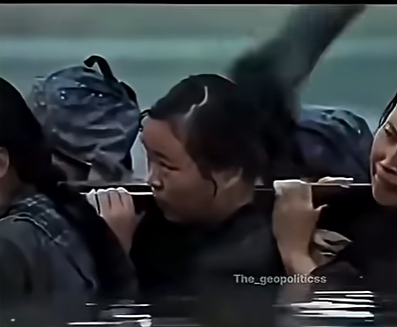
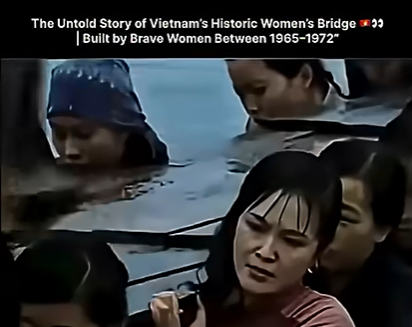
During the Vietnam War, after American bombing raids destroyed bridges across the country, groups of women stood shoulder to shoulder in rivers, holding wooden platforms above their heads so Vietnamese soldiers could cross safely. They carried no weapons and wore no armour. When the bridges disappeared, they became the bridge.
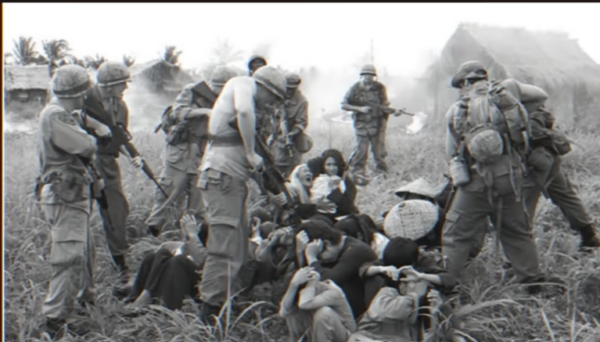
To understand what these women endured, it is necessary to understand the scale of the war around them. The United States dropped more than seven million tons of bombs on Vietnam, Laos, and Cambodia—more than twice the total tonnage dropped by the United States during the Second World War. Roads vanished overnight. Bridges collapsed into rivers. Villages that had stood for generations were reduced to rubble.
Amid that destruction, Vietnamese women became part of the country’s resistance effort.
In one of the most striking images captured during the war, women stood for hours in cold water, supporting makeshift platforms with their bodies while soldiers crossed above them. They received no medals for those moments and asked for none.
Many of them were barely adults. Nguyễn Thị Kim Huế was among 138,000 Youth Volunteers, most between the ages of seventeen and twenty-four, assigned to the Ho Chi Minh Trail. Their task was to keep vital military supply routes functioning despite constant aerial bombardment. Beyond them, an estimated 1.7 million women over the age of twenty-four joined local militias through the Women’s Union. They dug trenches, repaired roads, transported ammunition, defended villages, and supported military operations throughout the war.
The national slogan of the period declared that “when war comes, even the women must fight.” For many Vietnamese women, participation was not a matter of ideology alone. War had reached their homes, families, and communities.
Among them was Ngo Thi Tuyen. Only hours after her wedding in 1965, her husband was sent to the southern battlefield. She was assigned to transport ammunition for regular forces. That same night, American bombing raids struck the area.
Recalling the events years later, she said:
“Twenty-two of my comrades-in-arms were killed. But we had to defend the Dragon’s Jaw Bridge at all costs on that terrible night, and we had to keep the trucks going over it to the south.
I don’t know why I was able to carry those two big boxes of ammunition at that time. More than once, my strength came from anger and the need to avenge my dead comrades.”»
While others spent their wedding night with family, she spent hers carrying ammunition through explosions and stepping past the bodies of friends.
Nguyễn Thị Kim Huế remembered the bombing campaigns of 1966 with similar clarity.
“We had to rebuild the road every day because there were so many bombs. The worst B-52 attacks were in 1966. In my platoon, out of sixteen, ten were killed.”
When asked whether she had been afraid, she reportedly moved her hair aside to reveal a scar left by shrapnel and replied:
“No. Fear of what? You live once and you die once.”
Others arrived at the war through experiences that were deeply personal. Nguyen Thi Tien joined after witnessing bombs strike her village.
“They hit the farmers and the villagers died. I saw the bombs drop. It made me so angry.”
Nguyen Thi Van spent nights alone in the jungle maintaining communication lines.
“We were not afraid as we were too busy. We were not afraid of anything, even death. On duty alone at midnight in the jungle we were not afraid.”
These women were not mythical figures or symbols created after the war. They were ordinary people responding to extraordinary circumstances, carrying out tasks that the conflict demanded of them.
What followed after the war is a less familiar part of the story.
Many survivors of the volunteer brigades were never formally recognised as veterans and received few benefits. Some were unable to marry or have children. Others lacked the education and opportunities necessary to secure stable employment after years spent in wartime service. A number sought community in Buddhist convents or female collectives formed by former volunteers.
The transition from war to peace proved difficult for many of the women who had spent their youth supporting the country’s struggle.
Writer Phan Thanh Hao later reflected on their experience:
“They had to pick up the pieces, to act as peacemakers, to put their needs behind others again. Those who had husbands or parents to go back to were fortunate.”
More than half a century later, the women who carried ammunition, repaired roads, rebuilt bridges, and, in some cases, became bridges themselves remain far less known outside Vietnam than the soldiers whose movements they made possible.
Their names appear only briefly in many accounts of the war. Their stories survive in photographs, interviews, and the memories of those who witnessed what they endured.
The rivers they stood in have long returned to calm. The roads they rebuilt have been paved over. Time has moved on.
Their story, however, remains part of the history of a war that could not have been fought without them.
By Umm E Habiba, Punjab, Pakistan