

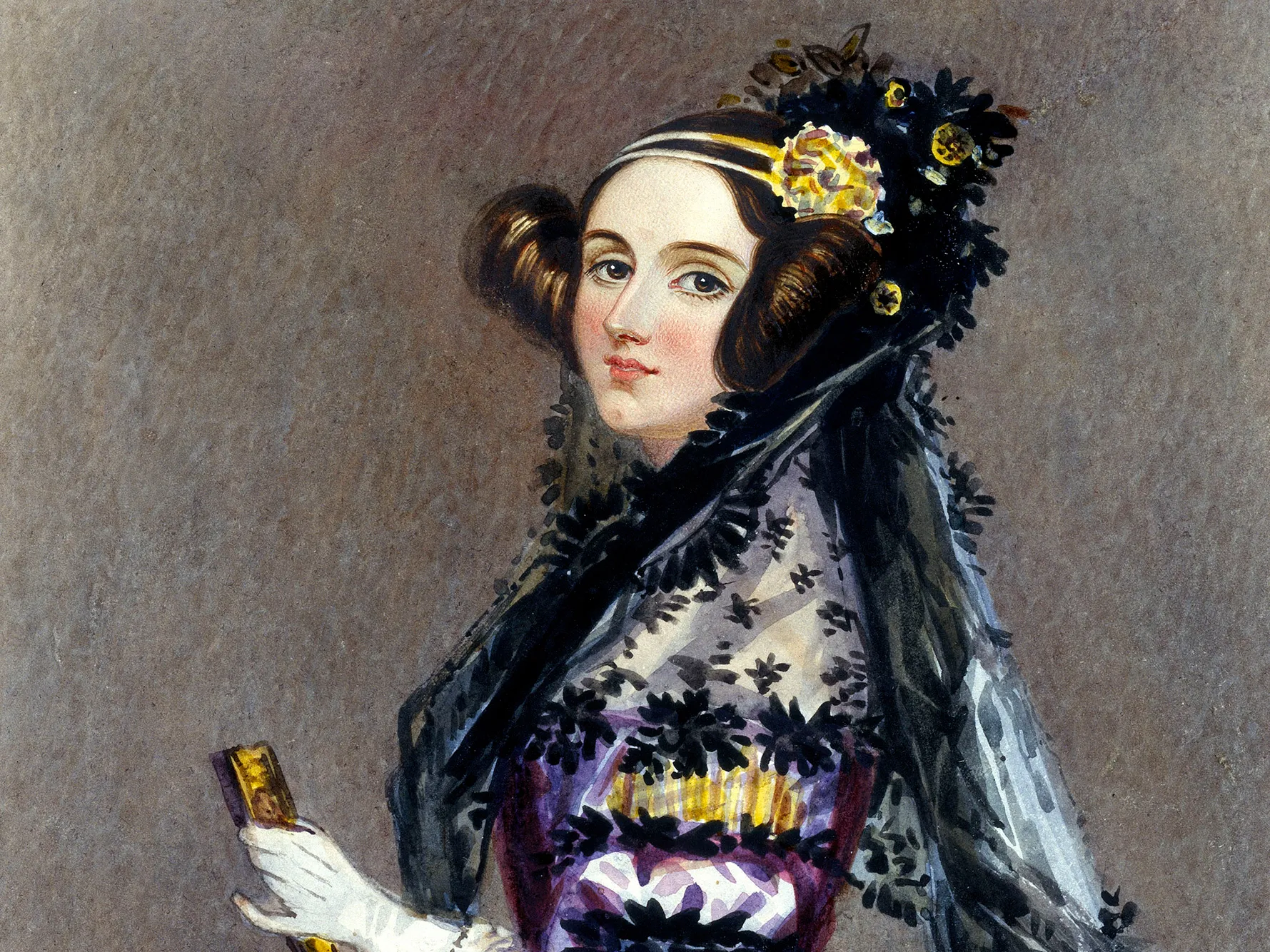
Long before the age of laptops, smartphones, and artificial intelligence, a woman imagined a world where machines could go beyond calculation and enter the realm of ideas. Her name was Ada Lovelace, and she is widely regarded as the first computer programmer in history. Her life is a story of imagination meeting mathematics, and of vision reaching far beyond the limits of her time.
Ada Lovelace was born on December 10, 1815, in London, England.
She was the daughter of the poet Lord Byron and Anne Isabella Milbanke, a highly educated woman with a strong interest in mathematics.
After her parents separated shortly after her birth, she was raised by her mother, who ensured she received an education grounded in logic, mathematics, and science.
From an early age, Ada showed a rare combination of analytical thinking and imagination. While many girls of her era were guided toward domestic expectations, she was encouraged to study mathematics and explore scientific ideas. This early foundation shaped her lifelong curiosity about machines, patterns, and systems.
As a teenager, she became fascinated with engineering and mechanical systems. She even studied birds and flight, sketching designs for a flying machine. Although these early experiments were never realized, they revealed her instinct to connect imagination with structure and logic.
A major turning point in her life came when she met the mathematician and inventor Charles Babbage. He was developing the Analytical Engine, a mechanical device designed to perform complex calculations automatically. While most people saw it as an advanced calculator, Ada saw something far greater.
She understood that the Analytical Engine could process more than numbers. In her view, it could follow instructions, manipulate symbols, and perform a wide range of tasks beyond arithmetic. This insight placed her far ahead of her time.
In 1842, Ada translated an Italian article about Babbage’s machine. However, her most important contribution came in the form of extensive notes that she added to the translation. These notes were longer than the original text and contained groundbreaking ideas about computation.
Within these writings, she described a method for instructing the machine to perform a sequence of operations. This included what is now recognized as the first published algorithm intended for execution by a machine. It is this contribution that led historians to identify her as the first computer programmer.
What makes her achievement extraordinary is the historical context. She wrote about programming concepts more than a century before the first modern computers were built. At a time when machines were purely mechanical, she envisioned a system capable of following symbolic instructions.
Ada also speculated on the broader potential of machines. She suggested that they might one day go beyond numbers to create music, process language, and support creative work. These ideas now reflect modern computing reality, where machines generate art, analyze data, and power global communication systems.
Despite her brilliance, Ada faced limitations shaped by the era in which she lived. Women in science were rarely given full recognition, and many of her ideas remained underappreciated during her lifetime. In addition, the Analytical Engine itself was never completed due to technical and financial challenges.
Ada Lovelace died in 1852 at the age of thirty six. Much of her work remained relatively unknown for decades after her death. However, as computing technology advanced in the twentieth century, her writings were rediscovered and reassessed. Scholars realized how accurately she had anticipated the future of computation.
Today, her legacy is recognized worldwide. A programming language was named Ada in her honor. Institutions across the world celebrate her contributions, and Ada Lovelace Day highlights the achievements of women in science, technology, engineering, and mathematics.
Her story is not only about mathematics or machines. It is about vision. Ada Lovelace saw possibilities where others saw limits. She understood that innovation begins with imagination and that ideas can outlive the conditions of their time.
More than a century before the digital age, she envisioned the foundations of computing. Today, her legacy stands as a reminder that progress often begins in the mind of someone willing to think beyond what already exists.
By Rukayya Muhammad Adam