
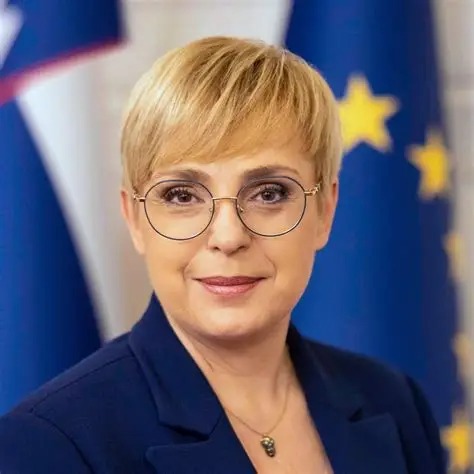
Nataša Pirc Musar was born on 9 May 1968 in Ljubljana, Slovenia, then part of Yugoslavia, a country that would cease to exist following the breakup of the federation.
From an early age, she developed an interest in things that demanded independence and courage. At just 15, she began riding motorcycles, an interest she has maintained throughout her adult life. Long before entering politics, she was already comfortable challenging expectations about what women could do.
She studied law at the University of Ljubljana, graduating in 1992, shortly after Slovenia declared independence. However, rather than immediately pursuing a conventional legal career, she took a different professional route that would eventually make her one of the country’s most recognizable public figures.
Her first major career was in journalism.
For six years, she worked as a journalist and news presenter for TV Dnevnik on Slovenian national television. She subsequently spent five years presenting 24ur, the main news programme on commercial broadcaster POP TV. Her work in television brought her into millions of homes and established her as a familiar face in Slovenian public life.
Journalism gave her something beyond public recognition. It exposed her to the relationship between information, public institutions and accountability, interests that would later define much of her professional career.
In 2001, she moved into the financial sector, working in corporate communications at Aktiva Group. She subsequently joined Slovenia’s Supreme Court as Director of its Education and Information Centre.
In July 2004, she was elected Commissioner for Access to Public Information. From 2005 until 2014, she served as Slovenia’s Information Commissioner, an important position responsible for overseeing access to public information and the protection of personal data.
The role placed her at the intersection of two fundamental rights: the public’s right to know and the individual’s right to privacy. It also required her to make decisions involving public institutions and powerful interests.
Her professional experience extended beyond Slovenia. She worked with European institutions, including Europol’s Joint Supervisory Body, and contributed to international efforts to strengthen data protection legislation. She also earned a doctorate in law from the University of Vienna in 2015, focusing on balancing access to public information with personal data protection.
But her career was not without setbacks.
In April 2014, she was selected to become Director-General of RTV Slovenia, making her the first woman chosen to lead the public broadcaster. The appointment was subsequently annulled, triggering a lengthy legal dispute.
In 2016, a higher court ruled that the annulment had been unlawful. The dispute eventually ended in a 2017 settlement under which RTV Slovenia agreed to pay her €70,000 in compensation.
The experience was a significant episode in her professional life, demonstrating how institutional decisions can become prolonged legal battles, even for individuals with considerable public experience.
Rather than withdraw from public life, she established her own law firm, Pirc Musar & Partners, in 2015. Her practice focused on legal matters involving human rights, privacy, freedom of information and media law.
She also attracted international attention through her legal representation of Melania Trump, the Slovenian-born former First Lady of the United States. Pirc Musar helped defend Melania’s reputation against publications and businesses that had used her name or circulated disputed claims about her past.
Beyond her legal career, she became increasingly involved in promoting women’s participation in professional and public life. She co-founded OnaVe, an initiative connecting Slovenian women experts and increasing their visibility in areas where women were often underrepresented.
For her, women’s representation was not simply about occupying positions. It was also about ensuring that women with the necessary qualifications and experience were recognised and given opportunities to contribute.
In 2022, she took her ambitions into electoral politics.
Running as an independent candidate, she contested Slovenia’s presidential election in a campaign that attracted considerable attention. Her candidacy faced scrutiny over her family’s financial interests, particularly the business activities of her husband, Aleš Musar. The issues became a major subject of political debate, placing her personal life under intense public examination.
She maintained that her professional record should be assessed independently of her husband’s business activities.
The first round of voting took place in October 2022, where she finished second. In the runoff election on 13 November, she defeated former foreign minister Anže Logar.
On 23 December 2022, she was sworn in as Slovenia’s fifth president and the first woman to hold the office.
Her election represented a historic development in a country whose highest political office had previously been occupied exclusively by men.
As president, she has used her international platform to speak on human rights, international law and global conflicts. At the 80th United Nations General Assembly in September 2025, she delivered a particularly forceful statement about the international community’s responsibility to prevent mass atrocities.
Reflecting on the Holocaust, the genocide in Rwanda and the genocide in Srebrenica, she called on world leaders to act over the suffering in Gaza.
“We did not stop the Holocaust. We did not stop the genocide in Rwanda. We did not stop the genocide in Srebrenica. We must stop the genocide in Gaza. There are no excuses anymore. None!”
Her position on Palestine also became visible in Slovenia’s domestic politics.
In June 2026, following the removal of the Palestinian flag from the government building after Janez Janša’s new government took office, Pirc Musar ordered the Palestinian flag to be raised at the Presidential Palace in Ljubljana. She said it represented a reminder of violations of international humanitarian law and the importance of human dignity.
The decision placed her in a public disagreement with the new government’s approach and demonstrated that she intended to use the visibility of her office to express her positions on international issues.
Her presidency has also faced scrutiny over matters closer to home.
On 31 July 2026, the presidential motorcade was involved in a collision in the Kastelec tunnel. Pirc Musar was among those injured, and the incident subsequently attracted considerable media attention. The presence of her longtime friend Viktorija Krivolucka among the passengers generated further questions about their personal and business connections. Krivolucka later publicly denied working for intelligence services.
The controversy illustrated the difficult relationship between public accountability and personal privacy, two issues that have been central to Pirc Musar’s professional life.
Throughout her career, she has occupied positions that demanded public scrutiny, legal judgement and the ability to withstand criticism. Her journey has moved through journalism, public administration, international legal work, private practice and ultimately the presidency.
Outside politics, she remains associated with the interests she has maintained for years, particularly motorcycling. She has continued to participate in events promoting women motorcyclists, encouraging greater participation and road safety.
Her story is not simply about becoming the first woman to occupy Slovenia’s highest political office. It is also about the different paths women can take into positions of influence, the institutional barriers they may encounter and the responsibility that comes with public leadership.
From a young woman who began riding motorcycles at 15 to a lawyer who challenged institutional decisions and eventually became president, Nataša Pirc Musar has built a career across several demanding professions.
Her journey raises an important question about leadership and representation: how many capable women remain outside positions of influence because institutions and societies are still uncomfortable with women who refuse to conform?
By Umm e Habiba, Pakistan.