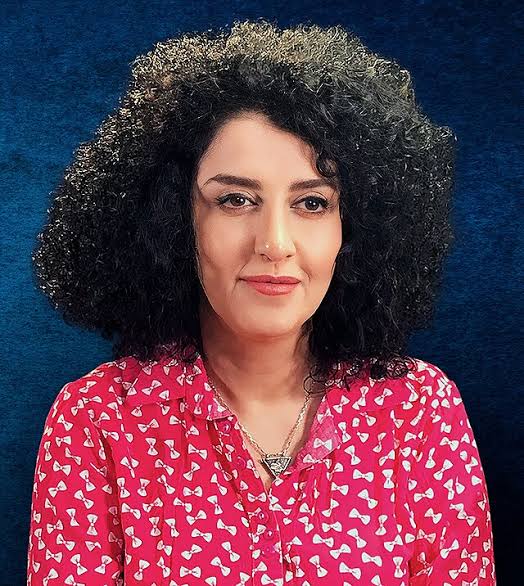
Human rights activist and Nobel Peace Prize laureate Narges Mohammadi has reportedly been temporarily released on bail and transferred to Tehran for urgent medical treatment, according to a statement issued by the Narges Foundation. The development has intensified international concern over her deteriorating health following multiple medical emergencies during her imprisonment in Iran.
Mohammadi, who received the Nobel Peace Prize in 2023 for her long-standing advocacy for women’s rights and her campaign against the death penalty in Iran, was transported by ambulance to Pars Hospital in Tehran. She is currently receiving treatment under the supervision of her personal medical team. According to the foundation, her prison sentence has been temporarily suspended in exchange for a substantial bail payment, though officials have not disclosed the exact terms or duration of the arrangement.
Her husband, Taghi Rahmani, who resides in Paris, confirmed the transfer through social media after reports emerged that Mohammadi had collapsed in her prison cell in the northwestern city of Zanjan, where she had been serving her sentence. Prior to the transfer, she had reportedly been hospitalized under strict security supervision.
Mohammadi’s brother, Hamidreza Mohammadi, stated that medical specialists had earlier recommended her transfer to Tehran for advanced treatment. However, he alleged that Iranian intelligence authorities initially blocked the decision. Following her eventual transfer, he expressed relief, saying the family had endured days of fear and uncertainty over her worsening condition.
Reports indicate that Mohammadi suffered two suspected heart attacks while in prison — one in March and another on May 1. After both incidents, she was reportedly hospitalized under heavy security surveillance. Her husband later revealed that her condition had become critical, citing severe drops in blood pressure and increasing difficulty speaking in the days leading up to her transfer.
Paris-based lawyer Chirinne Ardakani also shared a hospital image of Mohammadi, confirming that the activist had lost nearly 20 kilograms during her imprisonment. Ardakani noted that Mohammadi is now being treated by a dedicated medical team in Tehran, representing a significant improvement from the medical conditions she previously faced in custody.
Concerns over Mohammadi’s health extend beyond the recent cardiac episodes. Her family disclosed that she had earlier suffered a pulmonary embolism — a potentially life-threatening blood clot in the lungs — prior to her latest imprisonment in December 2025. Since her return to prison, she has reportedly endured persistent chest pain, severe headaches, dizziness, nausea, fluctuating blood pressure, and episodes of double vision. Human rights organizations say these symptoms point to a serious and ongoing decline in her health.
International rights group Amnesty International has strongly criticized Iranian authorities for allegedly denying Mohammadi access to specialized medical care. The organization described the situation as a form of torture, arguing that withholding essential treatment from a critically ill prisoner violates both international law and fundamental human rights standards.
Mohammadi was re-arrested in December 2025 after publicly criticizing the Iranian government during the funeral of a human rights lawyer. At the time, she had been temporarily released from Tehran’s notorious Evin Prison on medical grounds. Shortly after her remarks, she was detained again and accused of conspiracy and propaganda activities against the state.
In February 2026, she received an additional seven-and-a-half-year prison sentence, adding to a long history of arrests and legal persecution. Since first being imprisoned in 1998 for criticizing the Iranian government, Mohammadi has reportedly been arrested more than a dozen times.
Her case gained worldwide attention when she was awarded the Nobel Peace Prize in 2023 while still incarcerated, a recognition that highlighted her decades-long struggle for human rights, women’s freedom, and opposition to capital punishment in Iran. Her temporary release and hospitalization have once again drawn global attention to her condition, prompting renewed calls from activists and international organizations for her unconditional release.
Umm E Habiba,
Punjab, Pakistan.