The apartheid system did not merely separate races. By law, it declared Black children inferior, denied them quality education, stripped them of land ownership rights, forced them to carry identification documents to move within their own country, and subjected them to brutal punishment if they dared to resist. It was one of the most oppressive systems ever devised by human hands.
It was into this world that Netumbo Ndemupelila Nandi was born on October 29, 1952, in the small village of Onamutai, then part of South West Africa. Apartheid intended to limit her future before it had even begun. It had no idea who it was dealing with.
She was the ninth of thirteen children born to Petrus Nandi, an Anglican pastor, and Justina Nekoto Nandi. The family possessed neither wealth nor privilege and had little protection from the harsh realities surrounding them. As a child, Netumbo witnessed her people endure humiliation, dispossession, and systematic injustice. She attended St. Mary’s Mission School in Odibo, embracing every opportunity to learn while living in a society designed to deny people like her the chance to succeed.
In 1966, at just fourteen years old, she made a decision that would shape the course of her life. She joined the South West Africa People’s Organization (SWAPO), the liberation movement leading the struggle against South African occupation. She quickly became active in the Youth League in Ovamboland. Under apartheid, joining a banned organisation was far more than an act of defiance. It was a commitment to challenge an entire system built on oppression.
The authorities responded swiftly. In August 1973, she was arrested for protesting the imprisonment of SWAPO leaders. She spent her twenty-first birthday behind bars. For months, from August to December of that year, she remained imprisoned while fellow activists endured public floggings intended to intimidate and silence resistance. When she was finally released, she did not retreat into safety. Instead, she chose exile.
Leaving Namibia in 1973 meant leaving behind everything she knew and loved: her family, her community, and her homeland, with no certainty that she would ever return. She settled in Zambia, where she worked at SWAPO headquarters in Lusaka from 1973 to 1975. In 1975, she travelled to the Soviet Union to study at the Lenin Higher Komsomol School, refusing to allow exile to define her as a victim.
By 1976, she was addressing the United Nations Committee on Decolonization, speaking on behalf of her people before the international community. The young woman from a rural African village had become a powerful voice in the struggle for freedom.
She served as SWAPO’s Deputy Representative in Zambia from 1976 to 1978 and as Chief Representative from 1978 to 1980. From 1980 to 1986, she served as SWAPO’s Chief Representative for East Africa, based in Dar es Salaam, Tanzania.
During her years in Tanzania, she also built a family. In 1983, she married Epaphras Denga Ndaitwah, a senior commander in SWAPO’s military wing. Together, they would raise three sons while remaining deeply committed to the liberation struggle.
Even amid the demands of political activism, she never abandoned her pursuit of education. In 1987, she earned a postgraduate diploma from Glasgow College of Technology in Scotland. Two years later, she completed a Master’s degree in Diplomatic Studies at Keele University in England.
That same year, 1989, marked a turning point in Namibia’s history. South Africa finally agreed to Namibian independence, and after fourteen years in exile, Netumbo returned home.
On March 21, 1990, Namibia became an independent nation. On that historic day, she took her seat in the National Assembly and began a new chapter of public service.
From 1990 to 1996, she served as Deputy Minister of Foreign Affairs. Between 1996 and 2000, she served as Director General of Women’s Affairs. From 2000 to 2005, she was Minister of Women Affairs and Child Welfare, where she became a strong advocate for legislation protecting vulnerable members of society.
When opponents sought to undermine the Combating of Domestic Violence Bill, she stood her ground. Her determination contributed significantly to the law’s enactment in 2003, providing legal protection for thousands of women and children across Namibia.
Her rise through government continued. She served as Minister of Information and Broadcasting from 2005 to 2010, Minister of Environment and Tourism from 2010 to 2012, and Minister of Foreign Affairs from 2012 to 2015. In 2015, she was appointed Deputy Prime Minister. Two years later, she became the first woman ever elected Vice President of SWAPO.
In February 2024, following the death of President Hage Geingob, she became Vice President of Namibia, once again breaking new ground as the first woman to hold the office.
International recognition followed. She received African Leadership Magazine’s African Female Leader of the Year Award and the Inter-Generational Leadership Award at the 2024 Nala Feminist Summit. The University of Dar es Salaam honoured her with an honorary doctorate.
In April 2026, TIME magazine named her among the 100 most influential people in the world. In its tribute, UNAIDS Executive Director Winnie Byanyima highlighted a reality too often overlooked: African women played a central role in the struggle against colonialism and oppression.
Then came the moment that crowned decades of sacrifice.
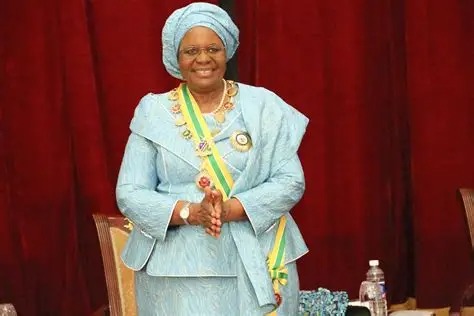
On March 21, 2025, exactly thirty-five years after Namibia’s independence, Netumbo Ndemupelila Nandi-Ndaitwah was inaugurated as the fifth President of Namibia and the first woman in the nation’s history to hold the office.
For a woman born into a system designed to deny her dignity, opportunity, and power, the achievement was extraordinary.
She had endured imprisonment, exile, separation from her homeland, and the long uncertainties of a liberation struggle. Yet she emerged not only as a survivor but as one of the architects of modern Namibia.
The system that sought to silence her voice could not contain it. The barriers meant to limit her ambitions only strengthened her resolve.
Apartheid underestimated her.
History did not.
A system built to make her nothing instead witnessed her become everything it said she could never be: a freedom fighter, a diplomat, a nation-builder, and ultimately, the first woman President of Namibia.
By Umm e Habiba, Pakistan.