
Service to the nation does not end with retirement.
Nigeria’s retired naval officers reaffirmed this while extending their commitment beyond the barracks to some of Nigeria’s most vulnerable children as part of activities to mark the 41st anniversary of the Nigerian Naval College 6th Regular Course (ONURA).
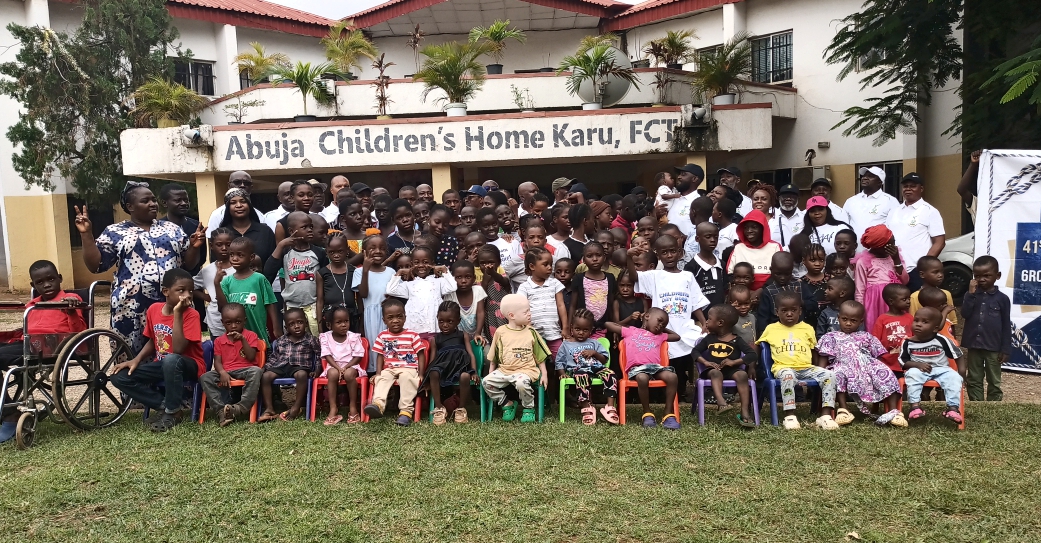
The retired Naval Officers visited an orphanage in Karu, Abuja, donated food items, essential supplies, and words of hope to the children.
The veterans said that caring for vulnerable children is a collective responsibility that should not be left to government institutions alone. They urged corporate organisations, fellow veterans, and well-meaning Nigerians to actively support children without parental care.
Speaking during the visit, Rear Admiral Idowu Yusuf (rtd) described the welfare of orphaned children as a national responsibility requiring collective action.
We hope other organisations, veterans and well-meaning Nigerians will see what we have done, take a cue from it and also support vulnerable children.
While acknowledging that charitable giving cannot be imposed, he stressed that compassion and social responsibility motivated the association’s decision adding that the outreach would not be a one-off event but part of an ongoing relationship with the children’s home.
in his speech, President of the association, Commodore Alex Nimyel (rtd), said the initiative was inspired by the oath of service members took when they joined the Nigerian Navy in 1985, and assured the children that the veterans intend to become a lasting support system.
From today, you will continue to see us. We are your fathers, your brothers, your sisters and your extended family.
According to Nimyel, after serving thier country to the best of thier ability while in uniform, they shall continue that service by giving back to society and reaching out to children who need love, encouragement and support. He encouraged the children to remain focused on their education and aspirations.
He cautioned them to study hard, remain disciplined and believe in themselves.
Among you are future doctors, engineers, military officers, governors and even presidents of this country.
Administrator of the orphanage, Mrs. Queency Patrick, expressed gratitude for the visit, noting that while the donated items would meet immediate needs, the veterans’ presence and encouragement carried even greater value.
She emphasized that raising and supporting vulnerable children should be viewed as a shared societal responsibility rather than the burden of orphanages or government alone, as the strength of any nation should be measured by how it treats its most vulnerable people cannot help themselves, whether they are children or the elderly.
Drawing from her own childhood experience, Patrick recounted how seeing a photograph of her aunt dressed as a lawyer inspired her to pursue a career in law, illustrating the lasting influence of positive role models.
She appealed to the veterans and other members of the public to go beyond material donations by investing their time and mentorship, saying yeyond the gifts and provisions, please give us something even more valuable, your time, your mentorship and your presence.
It is your guidance, affection and encouragement that will help ensure these children grow into responsible citizens, instead of becoming problems for society. If you come here any day and say, ‘I want to mentor a child, help with homework or simply encourage one of them,’ our doors are always open.
To reinforce her message, Patrick shared success stories of former residents, including a graduate now serving in the Nigerian Army and another employed by the National Drug Law Enforcement Agency (NDLEA) who both regularly return to mentor the children, demonstrating the transformative impact of sustained support.
She described the veterans’ visit as a reminder that meaningful change often comes through consistency, compassion, and genuine human connection rather than grand gestures.
For the retired officers, the outreach represented another chapter in a lifetime of service. But for the children, it offered more than food and supplies—it brought reassurance, encouragement, and the promise that they are not alone.
Umm E Habiba,
Punjab, Pakistan