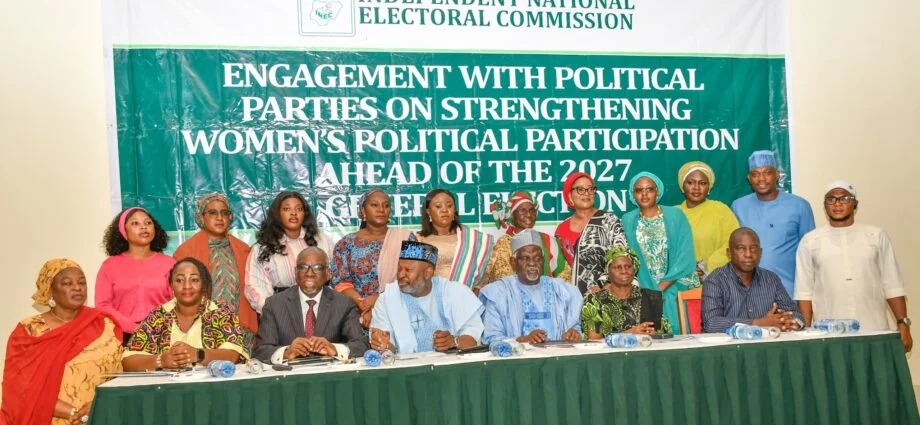
Nearly half of Nigeria’s registered voters are women, but their presence in elected office remains disproportionately low, highlighting a persistent gap between women’s participation at the ballot box and their representation in government.
The disparity was at the centre of discussions at a session organized by the Independent National Electoral Commission (INEC) in Abuja, where political parties were urged to move beyond commitments and take concrete steps to increase women’s participation in elective politics ahead of the 2027 general elections.
Registration data shows that women already participate in Nigeria’s electoral process in substantial numbers. The 2023 Register of Voters contained 93,469,008 registered voters, including 44,414,846 women, representing 47.52 per cent of the total.
More recently, figures from Phase III of the Continuous Voter Registration exercise showed women registering in higher numbers than men. A total of 2,037,589 women registered during the phase, compared with 1,830,408 men, representing 52.68 per cent and 47.32 per cent respectively.
That level of participation, however, has not translated into comparable representation among candidates or elected officials.
INEC Chairman, Prof. Joash Amupitan, represented at the Wednesday session in Abuja by National Commissioner Mr Rodah Gumus, said the figures from the 2023 general elections demonstrated the scale of the disparity.
“The data from the 2023 General Election is instructive. Of the 15,331 candidates across major elective positions, only 1,556, representing 10.15 per cent, were women,” Amupitan said.
Women’s representation was lower across individual elective positions. They accounted for six per cent of governorship candidates, 12.3 per cent of Senate candidates, 11.6 per cent of House of Representatives candidates and 10 per cent of State House of Assembly candidates.
The gap became even more pronounced after the elections.
“In the Senate, only three women were elected in 2023, representing 2.8 per cent of seats filled, and in the House of Representatives, only 16 women were elected, representing 4.4 per cent,” Amupitan added.
Mr Adebowale Olorunmola, Country Director of the Westminster Foundation for Democracy, said the figures place Nigeria among countries struggling significantly with women’s representation in political institutions.
“If you look at our reality now, continentally and globally, the figures are disheartening. Nigeria ranks 181 out of 188 countries in terms of women representation in parliament, with women occupying less than four per cent of legislative seats,” he said.
For INEC, political parties remain central to changing that pattern because of their role in determining who receives nominations and gains access to the electoral contest.
Amupitan described political parties as the main gatekeepers of political leadership and said the 2027 elections provide an opportunity for them to take practical measures to improve women’s chances of entering elective office.
Such measures, he said, should include providing women with equal access to campaign platforms, media exposure, fundraising opportunities, security and logistics, as well as protection from intimidation, harassment and political violence.
“Receiving a nomination should not be regarded as the end of the journey. It should be the beginning of a meaningful partnership between the candidate and her political party,” Amupitan said.
He also called for a longer-term approach to developing women’s political leadership beyond individual election cycles. Female candidates, whether successful or unsuccessful at the polls, could continue to contribute to governance through executive appointments, policy roles and other decision-making positions.
Secretary to the Commission, Dr Rose Oriaran-Anthony, represented at the session by Director of Gender and Inclusivity, Mrs Dorothy Bello, also pointed to the gap between women’s participation as voters and their presence in elected office.
She said closing that gap requires an environment in which women can aspire to political office, secure party nominations, campaign effectively and compete successfully.
Oriaran-Anthony called for sustained action across the political and electoral system rather than one-off initiatives introduced around election periods.
“As we look ahead to the 2027 general elections, we have an important opportunity to build on existing progress, address remaining gaps and work together to create greater opportunities for women to participate as voters, aspirants, candidates and leaders,” she said.
Olorunmola argued that efforts to increase women’s representation should also extend beyond formal party structures.
He urged advocacy organizations to engage what he described as “non-secretariat leaders” who, he said, can play significant roles in candidate selection and nomination processes.
He also called for gender-inclusion efforts to continue throughout the electoral cycle rather than becoming a recurring topic only as elections approach.
The session, organized by INEC’s Gender and Inclusive Department, brought together stakeholders to examine the barriers limiting women’s participation in Nigerian politics and possible ways of addressing them before the 2027 elections.
The figures presented at the meeting point to a clear divide: women constitute a substantial share of Nigeria’s electorate, but their representation among candidates and elected lawmakers remains considerably lower.
For the stakeholders at the session, addressing that divide will require political parties and other actors in the electoral system to translate commitments on women’s political participation into sustained measures that affect nominations, campaigns, security, financing and access to decision-making positions.
By Umm e Habiba, Pakistan