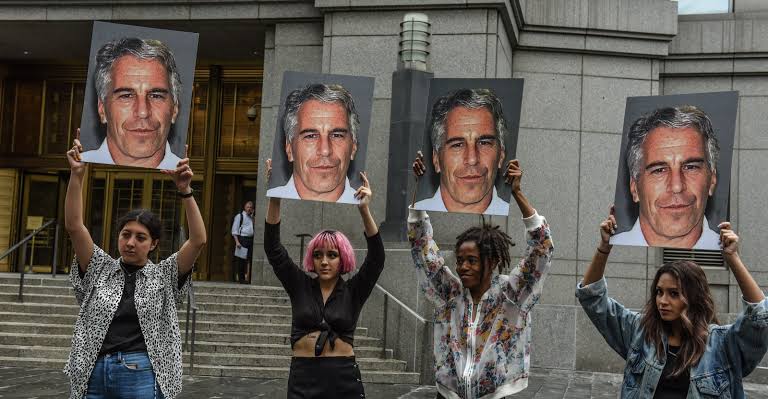
Some stories begin with glamour—private jets, marble mansions, and elite dinners where billionaires, politicians, academics, and royalty gather under crystal chandeliers. At the center of many of these rooms was Jeffrey Epstein, a financier who moved comfortably among the powerful. To the world, he appeared connected, respected, influential. But the real story did not begin in those rooms.
It began in quiet neighborhoods, in schools, in broken homes, in the lives of teenage girls who had no idea that the promise of easy money for a massage would become a doorway into something far darker.
She is fourteen. Someone approaches her gently, a friendly older girl who seems trustworthy. There is talk of opportunity, quick cash, no danger. Just a massage for a wealthy man. She needs the money. She believes the reassurance. The first visit feels confusing. Boundaries blur. The room is large. The man is older, powerful, calm, and assured. And then everything changes.
What prosecutors would later describe was not a single mistake or a misunderstanding. It was a system. Girls were recruited, paid, and sometimes encouraged to bring other girls. A chain of exploitation built quietly behind closed doors. For years, the world outside saw wealth and prestige. Inside, vulnerability was being traded.
In 2008, Epstein was investigated. There were victims, statements, and evidence. Yet the outcome shocked many observers: a plea deal that resulted in just thirteen months in jail, much of it served with work-release privileges.
As journalist Julie K. Brown wrote in The Miami Herald, “The plea deal was a secret that left victims and the public outraged. It protected a man who preyed on the most vulnerable.” For many survivors, the message was clear: power protects itself.
In 2019, new federal charges were filed, describing the trafficking of minor girls as young as fourteen across state lines. The scale suggested dozens, possibly hundreds, of victims over the years. Before a full trial could unfold, Epstein was found dead in his jail cell. His death was ruled a suicide. For many women around the world, it felt like something deeper had died too: the possibility of full public accountability.
Another figure loomed in the background. Ghislaine Maxwell was later convicted for helping recruit and groom underage girls. Her trial revealed disturbing details about how manipulation worked. Trust was built slowly, inappropriate behavior was normalized, victims were isolated, and wealth and status were used to intimidate.
As the court documents noted, “The abuse was systematic and deliberate, designed to maintain secrecy and control.” This was not chaos. It was strategy.
Why did this story resonate so deeply with women and girls around the world? Because it was not only about one man. It revealed how wealth can create social armor, how influence can delay justice, and how vulnerability can be systematically exploited. It showed how young girls can be manipulated into silence through fear, money, or shame. Abuse does not always hide in dark alleyways. Sometimes it hides behind respectability.
Women and girls from different countries, cultures, and economic backgrounds understood that fear is not abstract. If powerful men can operate for decades without consequence, if victims must fight for years just to be heard, and if systems respond slowly or unevenly, then safety begins to feel fragile.
The Epstein case became more than a criminal investigation. It became a symbol of structural imbalance, where power and gender intersect dangerously. This story is not only about the past. It is about a question that many women carry quietly today. Who will believe me? Who will protect me? Will justice arrive, or will influence silence it?
The harsh reality is not only the crimes committed. It is the ecosystem that allowed them to continue. As activist Tarana Burke has said, “Sexual violence thrives in silence. Speaking out is the first step toward justice.” The deeper conversation is not about one man. It is about ensuring that no girl’s vulnerability ever becomes someone else’s privilege again.
Umm E. Habiba
Punjab, Pakistan