In the quiet foothills of the Himalayas, where forests breathe life into rivers and farming is a way of living rather than an industry, a young girl grew up watching her mother sow seeds and her father protect forests.
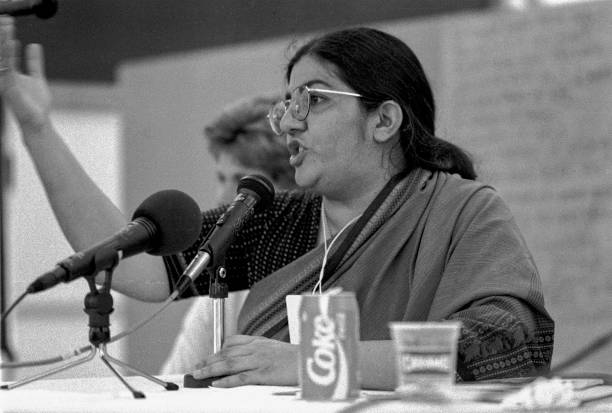
She is Dr. Vandana Shiva, who would later become one of the world’s most influential environmental activists, a leading voice in women empowerment, and a global symbol of ecofeminism and sustainable agriculture.
This is not just the biography of Vandana Shiva. It is the story of resistance, courage, and the belief that protecting the Earth and empowering women are inseparable struggles.
From Physics to the Living Earth
Born on 5 November 1952 in Dehradun, Uttaranchal now Uttarakhand India Shiva to a forestry official father, a farmer mother and grew up in Dehra Dun, near the foothills of the Himalayas, Vandana Shiva was trained not in activism, but in science. She earned a degree in Physics and later completed a Ph.D. in the Philosophy of Science, specializing in quantum theory at Guelph University, Ontario in 1976 and a doctorate from the University of Western Ontario in 1978.
At that stage, her future seemed destined for laboratories and academic journals. But life intervened when she developed an interest in environmentalism during a visit home, where she discovered that a favorite childhood forest had been cleared and a stream drained so that an apple orchard could be planted.
After completing her degrees, Shiva returned to India, where she worked for the Indian Institute of Science and the Indian Institute of Management. In 1982 she founded RFSTN, later renamed the Research Foundation for Science, Technology and Ecology (RFSTE), in her mother’s cowshed in Dehra Dun.
In the 1970s, as large corporations began cutting Himalayan forests for commercial gain, Shiva witnessed something that changed her forever. Village women stood before the trees, hugging them with their bodies, declaring that the forest was their lifeline.
Shiva proceeded to work on grassroots campaigns to prevent clear-cut logging and the construction of large dams. This was the Chipko Movement, and it revealed a truth no textbook had taught her. But this is something only people closest to nature understand it best.
She became a staunch critic of Asia’s Green Revolution (an international effort that began in the 1960s to increase food production in less-developed countries through higher-yielding seed stocks and the increased use of pesticides and fertilizers).
Shiva posits that the Green Revolution had led to pollution, a loss of indigenous seed diversity traditional agricultural knowledge, and the troubling dependence of poor farmers on costly chemicals.
That moment marked her transformation from physicist to Indian environmentalist and ecofeminist thinker. And in response, RFSTE scientists established seed banks throughout India to preserve the country’s agricultural heritage while training farmers in sustainable agricultural practices.
As industrial agriculture expanded, Shiva noticed that farmers who had saved seeds for generations were suddenly forced to buy expensive, patented seeds from multinational corporations. Indigenous knowledge was being erased, and biodiversity was collapsing.
In response, she founded Navdanya in 1991, a movement dedicated to seed sovereignty, organic farming, and biodiversity conservation. Navdanya means “Nine Seeds,” or “New Gift” in Hindi established dozens of community seed banks across India, many of them run by women.
The project, part of RFSTE, strove to combat the growing tendency toward monoculture promoted by large corporations. Navdanya formed over 40 seed banks in India and attempted to educate farmers on the benefits of conserving their unique strains of seed crops.
One of the most defining chapters in her life came with the Neem patent case. When an European corporation patented neem an ancient Indian medicinal plant, Shiva challenged the patent in international courts. After years of struggle, the patent was revoked.
This was a historic victory against biopiracy and a powerful statement that traditional knowledge matters.
Dr. Vandana Shiva and Women Empowerment: Power That Already Exists
For Dr. Vandana Shiva, women empowerment is not about giving women power but about recognizing the power women already hold and restoring what systems have taken away. She often challenges the very language of “empowerment” with a powerful statement made in interviews and public talks:
Women do not need to be empowered. Women are power
This single line captures her philosophy. According to Shiva, women have historically been creators of life, food, and community. What modern systems have done is erase their authority, not their capability. In interviews through Navdanya International Dr. Shiva repeatedly emphasizes that women especially rural women are not passive victims of poverty or climate change. They are the experts of it.
Women are the biodiversity and food experts. Women are the experts in economies of caring and sharing.
One of the strongest examples shaping her vision came from the Chipko Movement where rural women hugged trees to stop deforestation.
These women were not protesting for wages or positions.
They were protecting:
- Water sources
- Soil fertility
- Their children’s future
Shiva often recalls how these women understood ecology more deeply than trained foresters. This led her to a lifelong belief: that
Women’s empowerment is strongest when women control natural resources, not just income.
In her International Women’s Day speeches, Dr. Shiva connects women’s oppression to violent economic systems.
She states:
Capitalist patriarchy has created systems of violence; against women, against farmers, and against the Earth.
Vandana sees food sovereignty as the foundation of women’s freedom. Wherever women save seeds, control farming, and practice biodiversity, they gain economic independence, respect, and political voice; that is where development goes.
When women control food, they control life. When corporations control food, women are erased.” she adds
This inspired her to build women-led seed banks through Navdanya. Shiva’s ecofeminism focuses on cooperation, not domination. She emphasizes that
Women do not rule the world by domination. They sustain the world by cooperation with nature and communities
For Shiva, empowerment, means moving from competition to care, from extraction to regeneration, and from control to coexistence.
Her message is clear:
women are not backward, not dependent, and not powerless. They have been silenced, not weakened. Restoring women’s control over seeds, land, and food restores balance, justice, and ecological survival.
Through books like Staying Alive, The Violence of the Green Revolution, Biopiracy, and Earth Democracy, Vandana Shiva became a leading global critic of:
- Industrial agriculture
- GMOs (genetically modified organisms) and corporate seed monopolies
- Neoliberal globalization
- Chemical-intensive farming
While her views are sometimes controversial, she forced the world to question who controls food, science, and the future.
Dr. Vandana Shiva’s influence earned her international recognition, including the Right Livelihood Award (Alternative Nobel Prize).
Today, Vandana Shiva is more than an activist; she is a symbol of resistance, ethics, and feminism grounded in the Earth. Her work shows that protecting the environment and empowering women are deeply connected, and that small farmers and women are essential for a sustainable future.
And through that choice, she changed global conversations on environmental justice, sustainable development, and women’s leadership forever.