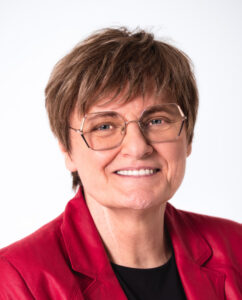
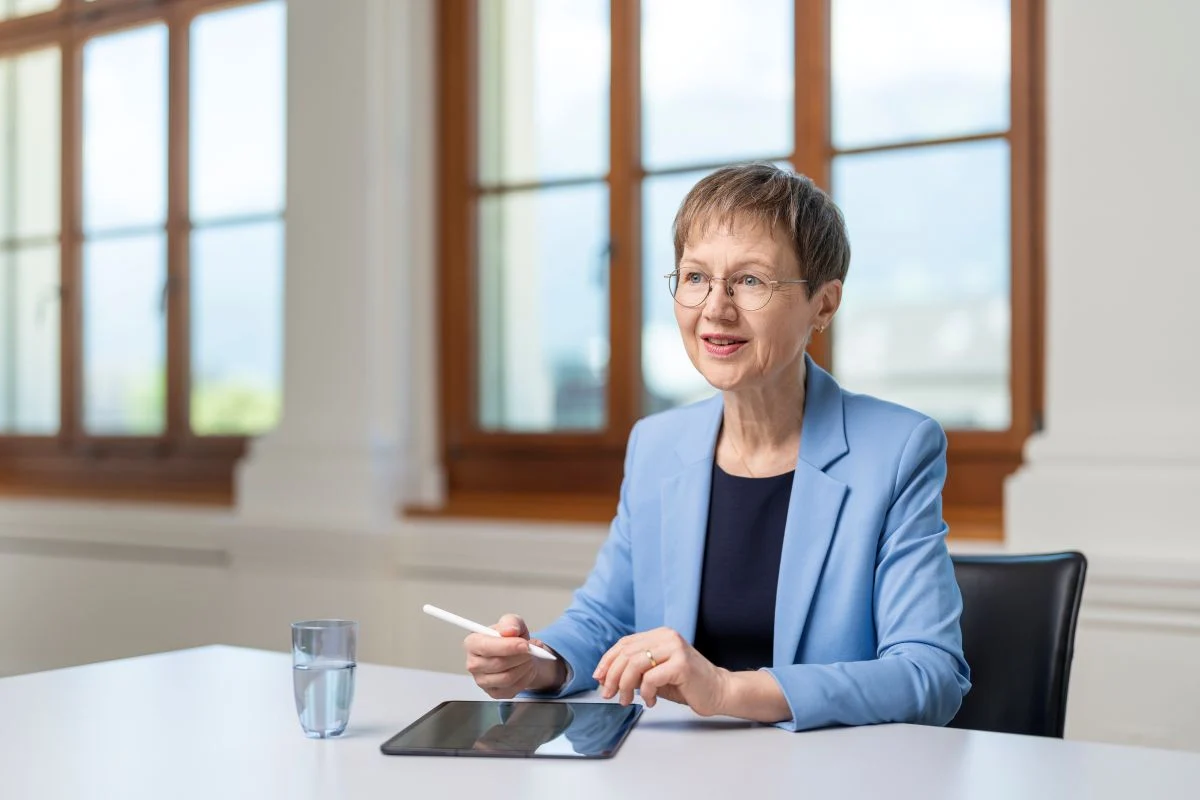
In a political landscape long shaped by tradition and male dominance, change does not always arrive with noise. Sometimes, it comes quietly, built over years of discipline, expertise, and persistence. In Liechtenstein, that change came in the form of Brigitte Haas, a leader whose rise reflects not sudden ambition but steady preparation.
Born on December 27, 1964, in Vaduz and raised in Schaan, Haas grew up in a society deeply connected to its institutions and traditions. Although she did not emerge from a dominant political dynasty, her environment exposed her to systems of influence and responsibility from an early stage. Through her marriage to Hubert Ospelt and her familial connection to Wolfgang Haas, the former Archbishop of Vaduz, she stood within reach of established authority, yet her journey remained distinctly her own, grounded not in inherited power but in earned competence.
Her educational path reflected both practicality and ambition. She began with commercial training, gaining a solid foundation in administrative work before advancing to study law at the University of Zurich, where she obtained a licentiate degree. This combination of administrative discipline and legal expertise equipped her with the tools required for complex decision making and institutional navigation. Rather than seeking early recognition in politics, she chose to build her career from within the system, developing a deep and nuanced understanding of governance.
For decades, Haas worked within Liechtenstein’s national administration, taking on roles that were often overlooked but fundamentally important. From assistant to clerical responsibilities and even serving as a personal assistant to the chief of police, she accumulated practical knowledge of how institutions operate on a daily basis. These experiences, though modest in title, provided her with something far more valuable than visibility. They gave her insight.
Her transition to the Liechtenstein Chamber of Commerce and Industry marked a significant step forward. Over nearly two decades, she rose steadily through the ranks, first as Deputy Managing Director and later as Managing Director. In this capacity, she engaged directly with economic policy, represented business interests, and navigated the complexities of maintaining competitiveness within a small but strategically positioned state. Her work during this period earned her a reputation for precision, pragmatism, and reliability, qualities that would later define her leadership.
For much of her professional life, Haas remained outside the center of political attention. Before 2025, she was not widely known in mainstream political circles. However, her entry into high level politics came at a moment when experience became more valuable than popularity. When Prime Minister Daniel Risch chose not to seek re election, the Patriotic Union required a candidate capable of offering stability and credibility. Haas stepped forward, not as a conventional politician driven by visibility, but as a professional prepared by years of quiet service.
Her campaign reflected this difference. It was not driven by populist rhetoric or dramatic promises but by a focus on economic stability, institutional knowledge, and pragmatic governance. In a time when political success is often associated with loud visibility, her approach stood out for its restraint and substance. Voters responded to this clarity, giving her party approximately 38.3 percent of the vote and placing it in a leading parliamentary position.
On April 10, 2025, Brigitte Haas was sworn in as the Prime Minister of Liechtenstein, becoming the first woman in the country’s history to hold the office. This moment marked more than a political transition. It represented a cultural shift within a nation where governance operates under a constitutional monarchy alongside Prince Hans Adam II and Hereditary Prince Alois. Her leadership signaled that even within deeply traditional systems, evolution is possible.
Haas approaches leadership with a philosophy shaped by her journey. She prioritizes pragmatism over ideology and values stability over spectacle, making decisions that reflect careful consideration rather than urgency. Her stance on key issues illustrates this balance, as she has opposed certain taxes such as inheritance tax, approached privatization with caution, and explored European integration with measured evaluation rather than haste.
What makes her story particularly significant is not only the position she holds but the path she took to reach it. In a global environment that often celebrates rapid success and visible ambition, Haas represents an alternative model. Her rise was built on decades of consistent effort, gradual professional growth, and the accumulation of trust within institutions. It reflects a form of leadership that is not loud but enduring.
For many women, especially those working behind the scenes or navigating spaces where recognition is limited, her journey carries a powerful message. Leadership does not always require visibility at the beginning. It can emerge from patience, from competence, and from a willingness to learn and grow over time. Power does not always belong to the loudest voice. Sometimes, it belongs to the most prepared.
Brigitte Haas is not only making history as the first female Prime Minister of Liechtenstein. She is quietly redefining what leadership can look like. Her story stands as a reminder that influence can be built steadily, that trust can be earned over time, and that true leadership is often less about performance and more about purpose.
Umm E Habiba,
Punjab, Pakistan.