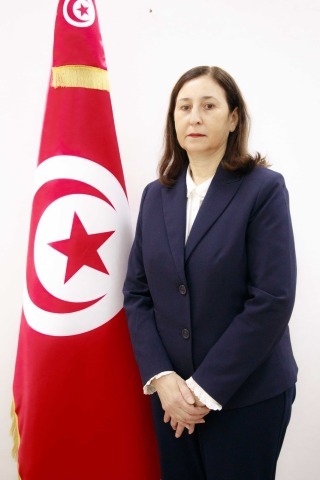
Women are often told to remain quiet, stay limited, or exist behind the curtain of expectations. Yet history continues to prove something remarkable: when a woman is given education, trust, and opportunity, she does not merely transform her own life, she transforms the future of an entire nation. Some women lead through powerful speeches and public charisma, while others lead through quiet resilience, discipline, and years of unwavering dedication. Sara Zaafarani Zenzari belongs to the second kind.
Sara Zaafarani Zenzari was born on January 26, 1963, in Tunis, Tunisia. She grew up during a transformative era in Tunisian history, only a few years after the country gained independence from France in 1956. Tunisia was attempting to modernize its institutions and expand educational opportunities, particularly for women. At a time when engineering remained overwhelmingly dominated by men, Sara chose a path that demanded intelligence, endurance, and courage.
In the early 1980s, she enrolled at the National Engineering School of Tunis, one of Tunisia’s most respected institutions for technical education. There, she studied civil engineering and built a strong foundation in infrastructure and construction. Her passion for technical knowledge later took her to Germany, where she pursued advanced studies in geotechnical engineering at Leibniz University Hannover during the late 1980s.
Studying abroad presented enormous challenges. It required adapting to a new culture, language, and academic environment. Yet over time, she mastered several languages, including Arabic, French, English, and German. Her journey reflected not only academic ambition, but also personal determination.
After completing her education, Sara Zaafarani began working in Tunisia’s Ministry of Equipment and Housing around 1989. Rather than entering politics immediately, she spent decades building her reputation as a technical expert and administrator. Throughout the 1990s and 2000s, she worked on infrastructure projects involving roads, housing, transportation, and regional development. Her responsibilities steadily expanded as she became involved in strategic national projects that directly influenced Tunisia’s modernization and economic growth.
During these years, she faced the quiet but persistent challenges experienced by many women in technical professions. Engineering and infrastructure management were sectors largely controlled by men, and female leadership remained uncommon. Yet Sara continued to rise through competence rather than publicity. She earned respect through consistency, careful planning, and administrative discipline.
By the 2010s, her experience in public works and infrastructure had established her as one of the most respected technocrats within Tunisia’s state administration. She participated in the supervision of major transportation and development initiatives, including projects connected to highways and regional infrastructure improvements.
In October 2021, Sara Zaafarani reached a major milestone when Tunisian President Kais Saied appointed her as Minister of Equipment and Housing. The position placed her at the center of Tunisia’s infrastructure and development policies during a period of severe economic pressure. Tunisia was struggling with unemployment, inflation, and growing public frustration following years of political instability after the Arab Spring.
As minister, she supervised public housing programs, infrastructure modernization, and transportation projects. In March 2024, her responsibilities expanded further when she also became the acting Minister of Transport after a cabinet reshuffle. Her growing influence within the government reflected increasing trust in her administrative abilities.
Then came the historic moment that transformed her life and secured her place in Tunisia’s political history.
On March 21, 2025, President Kais Saied appointed Sara Zaafarani as the Prime Minister of Tunisia. With that appointment, she became only the second woman in Tunisia’s history to hold the office. Her rise became a powerful symbol for women across Tunisia and the wider Arab world, especially for young women pursuing careers in science, engineering, and public service.
Her appointment came during one of the most difficult periods Tunisia had faced in recent years. The country was dealing with economic hardship, migration pressures, shortages of basic goods, and political tension. Leading under such conditions required enormous resilience and responsibility.
Unlike many modern political leaders who rely heavily on media campaigns and emotional rhetoric, Sara Zaafarani became known for her calm and technical leadership style. She focused on implementation, structural reform, and state administration rather than political spectacle.
One of her most widely quoted public statements came during discussions surrounding regional sovereignty and international affairs, when she declared:
“Tunisia believes peoples must act according to their own choices and their full sovereignty, without imposed agendas or foreign dictates.”
The statement reflected her belief in national sovereignty and independent decision making. It also became one of the defining lines associated with her leadership.
Throughout 2025 and 2026, she continued emphasizing economic reform, infrastructure expansion, development strategies, and African cooperation in her speeches. She called for “a more just and equitable global economic system” while representing Tunisia at international forums and conferences.
Although there are no widely documented personal tragedies or dramatic scandals attached to her story, her true hardship can be seen in the long and demanding journey she endured over decades. She built her career step by step within institutions where women rarely reached the highest levels of leadership. Her success was not sudden. It was earned slowly through education, technical expertise, and perseverance.
Sara Zaafarani’s story stands out because she represents a different model of political leadership. She is not defined by loud populism or constant media appearances. Instead, she represents competence, professionalism, and quiet strength. Her life sends a powerful message that women do not need to imitate others to lead successfully. Knowledge, patience, and dedication can be just as powerful as charisma.
Today, Sara Zaafarani remains one of the most significant female political figures in modern Tunisia. From a young engineering student in the 1980s to Prime Minister in 2025, her journey reflects the transformative power of education and determination.
For many women across the Arab world and beyond, her rise continues to symbolize possibility, resilience, and the enduring belief that no field is beyond a woman’s reach.
UMM E HABIBA, Punjab, Pakistan