
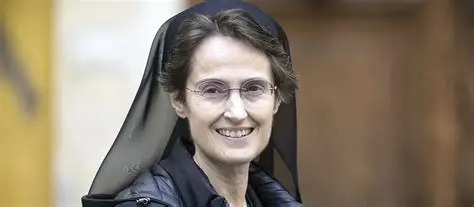
Raffaella Petrini was born in Rome on January 15, 1969. Nothing marked her birth as extraordinary, yet she would grow up to achieve something no woman in the history of the Catholic Church had done before.
She built her path through study as much as faith. She earned a degree in political science from LUISS in Rome, specializing in industrial relations. She then moved to the United States, completing a master’s degree in Organizational Behavior at the University of Hartford in Connecticut.
By 2015, she had earned a doctorate in Social Sciences from the Pontifical University of Saint Thomas Aquinas (the Angelicum), where she later returned as a lecturer.
That same year, she published Health, Equity and Care Through the End of Life, where she argued that economic systems often misclassify care—for the sick, the elderly, and the vulnerable—as a cost rather than a form of value. That idea would later define her approach to leadership.
Before any titles or appointments, she made a personal commitment that reshaped her life. She joined the Franciscan Sisters of the Eucharist, a religious order based in Meriden, Connecticut. The process was long and deliberate: years of discernment, formation as a postulant, time as a novice, temporary vows, and finally perpetual vows. She chose a life defined by poverty, obedience, and service, without personal wealth or family life as the world typically understands it.
In 2005, she began working at the Vatican within the Congregation for the Evangelization of Peoples. For sixteen years, she carried out largely unseen administrative work while also teaching Welfare Economics at the Angelicum.
It was a long period of quiet service, far from public recognition.
Everything changed in November 2021, when Raffaella Petrini was appointed Secretary General of the Governorate of Vatican City State, the second-highest executive role in the Vatican’s civil administration. It was the first time a woman had ever held the position.
Then, in January 2025, Pope Francis signaled an even greater shift during a televised interview on Che Tempo Che Fa, noting that “we now have many women” in leadership roles within the Church—an indirect reference to changes already underway.
On February 15, 2025, the appointment became official. Petrini was named President of the Pontifical Commission for Vatican City State and President of the Governorate, succeeding Cardinal Fernando Vérgez Alzaga upon his retirement. She assumed office on March 1, 2025, becoming the first woman in history to govern the civil administration of Vatican City State.
The timing gave the moment added weight. At the time of the announcement, Pope Francis was receiving treatment at Gemelli Hospital for a respiratory infection, yet the decision proceeded.
In 2026, under Pope Leo XIV, her influence expanded further. On February 3, 2026, she was appointed to the Commission for Reserved Matters, which oversees some of the Vatican’s most confidential financial affairs. She became the first woman to serve on that body.
Petrini has often described leadership in moral and relational terms. Speaking at the University of the Holy Cross in Rome on International Women’s Day, she emphasized that women in leadership are “called today to exercise their freedom to carry out their tasks… to care for the weak and to place the dignity of the person at the center of every decision.” She frequently refers to this vision as building “social friendship.”
Her rise was not without complexity. Petrini had to establish credibility twice: first as a scholar within a clerical academic world, and later as an administrator overseeing healthcare, security, museums, and financial systems for a sovereign state.
She also carried the symbolic weight of being the first woman to hold such authority in an institution that had been governed exclusively by men for centuries.
By 2026, she was speaking at global platforms such as the AI for Good Summit and was named principal commencement speaker at the University of Notre Dame, where she would also receive an honorary degree.
Notre Dame President Father Robert Dowd described her as “an extraordinary leader who works tirelessly for the common good and radiates the peace, love, and hope of Christ.”
Petrini never set out to make history. She set out to study, to serve quietly, and to place care at the center of systems that often overlook it. History did not announce itself to her.
It arrived later—after she had already spent decades preparing to meet it.
Umm E Habiba,
Punjab, Pakistan.