
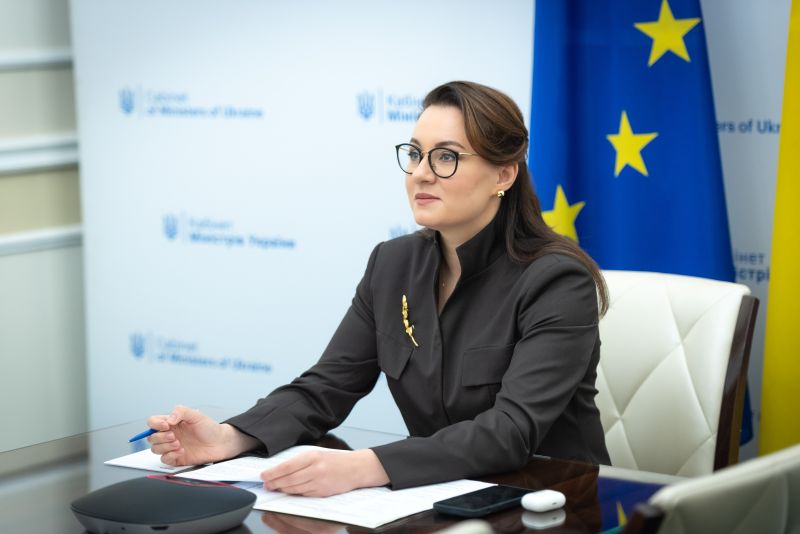
Leadership in times of crisis is rarely shaped overnight. In the case of Yuliia Svyrydenko, Ukraine’s Prime Minister, it is the outcome of years of education, steady public service, and a consistent focus on economic resilience and human capital. Her journey reflects how preparation, rather than spectacle, defines leadership when a country is under extraordinary strain.
Early Life and Education (1985–2008)
Born in 1985 in Chernihiv, northern Ukraine, Yuliia Svyrydenko grew up with early exposure to public administration through her family environment. While her initial interests leaned toward music, she studied piano seriously during her youth, she ultimately chose a more pragmatic academic path aligned with national economic development.
In 2008, she earned a Master’s degree in Antimonopoly Management from the Kyiv National University of Trade and Economics. Her studies focused on competition policy, market regulation, and economic governance fields that later became central to her public service roles.
Following her degree, she pursued professional certifications in business valuation, real estate appraisal, securities, and intellectual property valuation, strengthening her technical expertise.
She also completed executive and management training programs in Germany and Sweden, gaining exposure to European governance and economic models.
Early Career and Entry into Public Service (2008–2015)
After completing her education, Svyrydenko began her career in the private sector in 2008, working as an economist and valuation specialist. These early years developed her analytical skills and introduced her to performance-driven environments.
In 2015, she transitioned into public service, joining the Chernihiv Regional State Administration. Over the next three years, she held several senior roles, including Head of the Department of Economic Development and First Deputy Head of the regional administration. In 2018, she served as Acting Head (Governor) of Chernihiv Region, managing regional development and economic planning during a period of national reform and political transition.
Rise to National Leadership (2019–2021)
Svyrydenko entered national government in 2019, when she was appointed Deputy Minister of Economic Development, Trade, and Agriculture. In 2020, she was promoted to First Deputy Minister, and later that year became Deputy Head of the Office of the President of Ukraine.
These roles placed her at the center of national economic strategy and executive decision-making. By November 2021, she was appointed First Deputy Prime Minister and Minister of Economy, just months before Ukraine faced the full-scale invasion that transformed every aspect of governance.
Governing During War and Path to Prime Minister (2022–2025)
From 2022 onward, Svyrydenko’s responsibilities expanded dramatically. Economic policy shifted from growth planning to survival, resilience, and reconstruction. She became a key figure in coordinating wartime economic measures, supporting domestic production, and engaging with international partners on recovery frameworks.
In July 2025, she was confirmed as Prime Minister of Ukraine, becoming only the second woman in the country’s history to hold the position.
Her appointment came under martial law, fiscal pressure, and intense public expectations, underscoring the trust placed in her technocratic and results-oriented leadership.
Engagement with Youth and Human Capital Development
During an official visit to Uzhhorod, Prime Minister Svyrydenko met with students of the Faculty of International Economic Relations, emphasizing the central role of young people in Ukraine’s economic future. She discussed grant programs, concessional loans, and entrepreneurial initiatives designed to support Ukrainians who continue to work, innovate, and produce goods despite wartime conditions.
In her remarks, she highlighted that Ukraine’s greatest asset is its people, stressing that state policy must prioritize education, entrepreneurship, and opportunities for young Ukrainians to contribute meaningfully to national recovery. The meeting reinforced her consistent message that economic resilience begins with investing in human potential.
Women’s Economic Empowerment and Gender Equality
Svyrydenko has also been a prominent voice on women’s economic participation, particularly during Ukraine’s wartime recovery. At the Women’s Economic Empowerment Congress (WEE Congress)—organized by UN Women with the support of the Ministry of Economy—she addressed policymakers, businesses, NGOs, and international partners on the need for structural gender equality.
She underscored that women’s entrepreneurship and workforce participation are essential to national economic resilience, particularly amid full-scale war.
According to Svyrydenko, removing barriers to career advancement and ensuring equal opportunities for women are among the government’s key priorities.
She also highlighted the crucial role women play in Ukraine’s recovery and called for expanding programs that support women’s professional fulfillment and leadership.
Recognition and Achievements
Over the course of her career, Svyrydenko has received formal recognition for her contributions to public service, including the Honorary Certificate of the Cabinet of Ministers of Ukraine.
In 2023, she was also recognized internationally when she was included among TIME magazine’s emerging global leaders, reflecting her influence during a period when Ukraine’s economic decisions had global significance.
Yuliia Svyrydenko’s journey, from her academic training in economics to regional administration, national leadership, and ultimately the prime ministership, illustrates a model of leadership.
Her focus on youth, women’s economic empowerment, and human capital reflects a broader understanding that sustainable recovery depends not only on policy, but on people.
For NGOs and civil society organizations, her leadership narrative offers an important lesson: resilience is built by investing in education, equality, and opportunity, especially in times when those values are most difficult to protect.
Umm E Habiba,
Punjab, Pakistan.