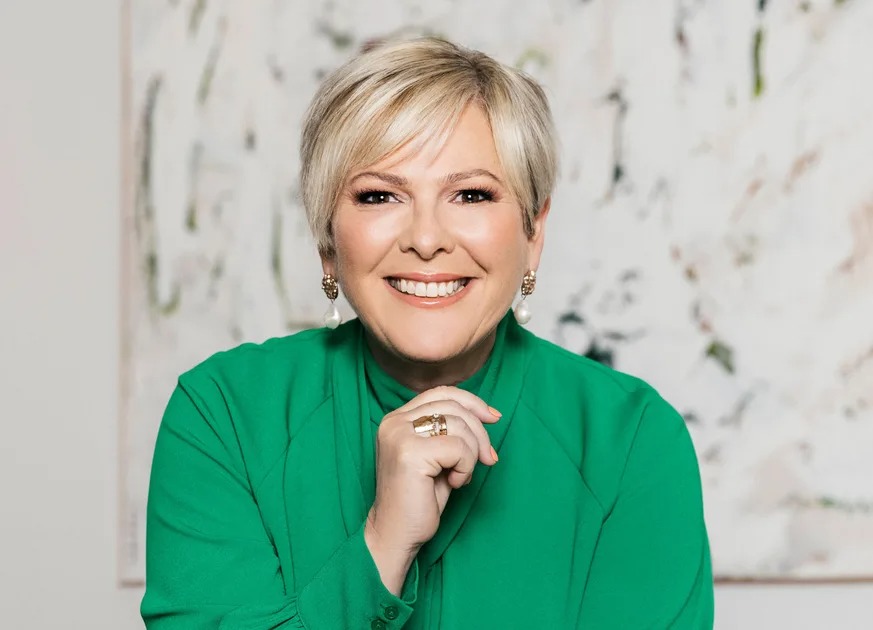
Reykjavík, 1968. A plumber and a social educator welcomed a daughter on 11 October. Nothing about her birth suggested that she would one day become president. There was no political dynasty behind her, no inherited name opening doors. What she had instead was a small, resilient country and parents who worked with their hands and their hearts.
Like other Icelandic children, she began compulsory schooling at around six, growing up in the classrooms and hallways of Reykjavík in the early 1970s. Then, on 24 October 1975, something happened that would shape her more profoundly than any classroom ever could.
She was seven when almost every woman in Iceland, including her mother and aunts, walked away from paid and unpaid work for a day to demonstrate what the country would look like without women’s contributions. Halla has since recalled how proud she felt watching them. Like children everywhere, she simply wanted to matter, too. That day planted something in her that would take nearly five decades to fully bloom.
Five years later, in 1980, Iceland elected Vigdís Finnbogadóttir, the world’s first democratically elected female head of state. Halla was twelve. Imagine a young girl in Reykjavík watching a woman occupy the highest office in the country and quietly learning that the seemingly impossible was, in fact, possible.
In 1986, Halla graduated from Verzlunarskóli Íslands and crossed the Atlantic as an exchange student to Central High School in Evansville, Indiana. That October, she became one of six homecoming queen finalists and finished second. It was a small loss, perhaps forgettable to everyone but her, but it offered an early taste of the disappointment she would encounter again on a much larger stage.
She built her career brick by brick. She earned a business degree from Auburn University at Montgomery in 1993 and a master’s degree from Thunderbird School of Global Management in 1995. She then spent a decade working in human resources at Mars and Pepsi-Cola—quiet, demanding work that helped shape the leader the world would later come to know.
Back in Iceland, she helped establish Reykjavík University in 1998 and built its women’s entrepreneurship programme. She went on to become the first woman to lead the Iceland Chamber of Commerce.
In 2009, the Cartier Women’s Initiative recognized her as a European laureate for women’s entrepreneurship, an early indication that advocating for women was becoming a defining part of her life’s work. Two years later, Newsweek named her among its 150 women who “shake the world.”
In 2007, Halla and Kristín Pétursdóttir co-founded Auður Capital, a company built around values such as honesty, independence and responsible leadership rather than a culture of unchecked greed. A year later, Iceland’s banking system collapsed, plunging the country into a financial crisis and turning it into an international symbol of economic ruin. Auður was among the firms that protected its clients through the crisis.
Halla later contributed to Iceland’s recovery through the National Assembly of 2009, where ordinary citizens gathered to discuss the country’s future and consider what kind of society should emerge from the crisis.
Her advocacy for women continued to grow. In 2015, marking the centenary of Icelandic women’s suffrage, she founded and chaired WE 2015, a global dialogue on closing the gender gap that brought leaders from around the world to Reykjavík. She has argued that greater gender balance in finance, business and politics would contribute to a safer and more sustainable world. Her philosophy is straightforward: it is often easier to change a system from within than to stand outside it and simply criticise.
She has also repeated a belief that captures much of her approach to leadership: “What we see, we can become.” For her, the visibility of women in positions of power is not symbolic alone; it can expand what the next generation believes is possible.
Then came her most significant political setback.
In 2016, Halla ran for president for the first time. Just 45 days before the election, she had only about one percent support in the polls. By election day, she had climbed dramatically to 27.9 percent—but still lost.
The New Yorker, observing her concession, described her as “a living emoji of sincerity.” Behind the composure, however, was doubt. Halla later acknowledged that she was unsure whether she would ever run again. For years, she wrestled with self-doubt and what she came to describe as impostor syndrome, eventually learning not to eliminate those feelings but to live with them.
From 2018 to 2024, she led The B Team, a global nonprofit focused on sustainability, equality and responsible business, taking her advocacy for a fairer and more gender-balanced world onto the international stage.
Then, in 2024, she tried again.
Beginning the campaign with polling support of around five percent, Halla steadily gained ground. On 1 June 2024, she won Iceland’s presidential election with 34.3 percent of the vote. Two months later, on 1 August, she was sworn in as Iceland’s seventh president—and only the second woman to hold the office.
The journey had taken nearly five decades.
As president, Halla has continued to speak about the cause that first touched her at seven years old. In 2025, marking 50 years since Iceland’s historic Women’s Strike, she joined filmmaker Pamela Hogan to commemorate the anniversary and tell the story of the day her mother helped teach her that women’s work sustains society.
When asked what she would tell her 18-year-old self, her answer was simple: be yourself, and know that you are already enough.
Perhaps that is the most fitting lesson in her story.
She lost. She doubted herself. She stepped away. She tried again.
And eventually, she won.
Umm E Habiba, Punjab, Pakistan.