
The Gozitan Who Outlasted Every Closed Door
On the small island of Gozo, separated from Malta by a narrow channel of blue water, a remarkable political life began with a quiet piece of parental wisdom.
Born Miriam Zammit in Victoria, Gozo, in 1952, Myriam Spiteri Debono grew up under the watchful eye of her father, Pawlu. When she eventually stepped into Labour politics, he offered her a simple, grounding caution: “Don’t put your trust in princes.” It was a philosophy that would sustain her through decades of public service, political change and closed doors.
Long before she entered the halls of power, she forged her own path through education and professional independence. In 1973, she graduated from the University of Malta with honours in English Literature and Linguistics and was among the founders of the Socialist Students Union. By 1980, she had qualified as a notary, becoming one of the first women in Malta to enter the profession. She also taught in government secondary schools and worked in the tax department.
Her commitment to the Malta Labour Party deepened during the 1980s. She joined the Balzan Labour committee, entered the party’s national executive, chaired the Cooperatives Board and eventually led the party’s women’s section. For 16 consecutive years, she was elected by the party’s General Conference to its executive committee.
But while her influence inside the party grew, the ballot box remained elusive.
Spiteri Debono contested five general elections, in 1981, 1987, 1992, 1996 and 2003, but was never elected to Parliament.
That electoral record, however, did not end her public life. If anything, it became part of the story of how she eventually reached Malta’s highest constitutional office.
In 1996, following Labour’s victory, Spiteri Debono was appointed Speaker of the House of Representatives. She became the first woman to hold the position in Malta, serving from 1996 to 1998.
It was a demanding period in Maltese politics. As Speaker, she presided over Parliament during a turbulent political era before leaving the chair in October 1998.
But public service did not end when the speakership did.
Over the following years, Spiteri Debono continued to serve in public institutions. She chaired the Press Ethics Commission during the first three years of its existence and was instrumental in drafting its first rules of procedure and bylaws. From 2009 to 2024, she also served on the board responsible for recommending recipients of Malta’s Republic Day honours.
Her public interventions also reflected a longstanding concern for democratic institutions and the role of journalism. In 2021, she used a Victory Day speech to pay tribute to murdered journalist Daphne Caruana Galizia and defend the importance of investigative journalism, drawing controversy after the government’s information department chose not to broadcast the address.
In January 2023, the Nationalist Party approached her about becoming Standards Commissioner. She declined to be considered for the position.
Then, in March 2024, the story took another historic turn.
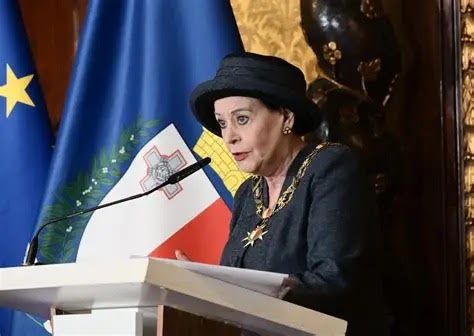
The Maltese Parliament approved her nomination as President of the Republic with 75 votes in favour and none against. The unanimous parliamentary vote made her Malta’s 11th President, its third woman president and the third person from Gozo to hold the office.
It was a remarkable destination for someone who had spent decades attempting to enter Parliament through electoral politics without winning a seat.
Her presidency has given her a national and international platform. She has spoken about democratic representation, gender equality, violence against women, children’s rights and the need for stronger institutional participation.
In October 2025, she addressed the Parliamentary Assembly of the Council of Europe in Strasbourg, where she spoke about the continuing underrepresentation of women in political and institutional leadership. “Change does not happen by chance,” she told the assembly, arguing that progress requires persistence and collective action.
Her public role has also extended to social welfare. As President, she has been closely associated with the Malta Community Chest Fund Foundation and its L-Istrina fundraising telethon, which supports people and families facing serious medical and financial challenges.
Behind the public figure, however, has been a woman who has also faced profound personal loss.
In July 2025, her husband, notary Anthony Spiteri Debono, died at the age of 78 after a rapidly progressing illness. The couple had three children.
The loss became particularly poignant because of the President’s connection to families dealing with serious illness through her public work. In a later interview, she spoke about how quickly her husband’s condition deteriorated and how difficult it was to watch the illness progress.
For someone whose public life has been defined by perseverance, grief became another chapter in a journey marked by duty.
Today, Myriam Spiteri Debono remains President of Malta, with her term continuing toward 2029. Her path to the presidency was not built on a long parliamentary career or a string of electoral victories. Instead, it was shaped by decades of political participation, professional service, institutional responsibility and persistence.
She never won a parliamentary seat.
But in March 2024, 75 members of Malta’s Parliament voted for her without a single vote against.
Her story is therefore not simply about losing elections and eventually becoming president. It is about a woman who continued to serve when electoral success remained out of reach, built credibility through institutions beyond the ballot box and eventually reached the highest office in her country through an unprecedented consensus in Parliament.
From the political candidate who could not secure a seat to the woman entrusted with Malta’s highest constitutional office, Myriam Spiteri Debono’s journey shows how a long public life can take unexpected turns.
Sometimes, the road to the highest office is not paved by electoral victories alone.
By Umm e Habiba, Pakistan