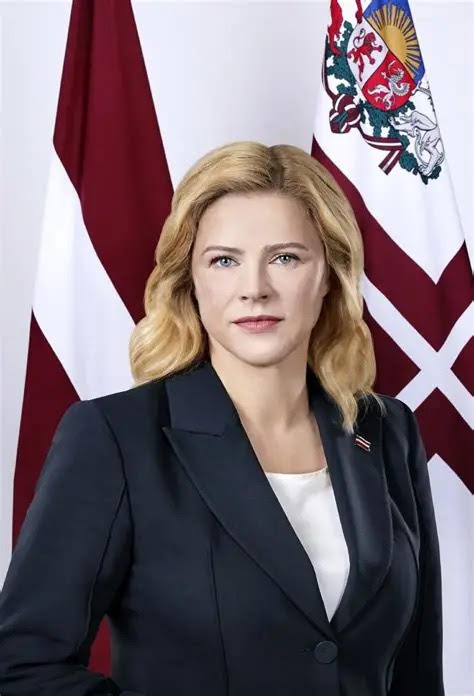
For years, Evika Siliņa worked behind the scenes of Latvian politics, advising ministers, navigating legislation and helping shape government policy. Then, in September 2023, the lawyer who had spent much of her career away from the political spotlight became Latvia’s prime minister.
Her premiership lasted less than three years and was marked by questions of national security, women’s rights, coalition instability and major political challenges. In May 2026, she resigned. Months later, her party suffered a major electoral setback.
Siliņa’s political journey, however, began long before she entered the highest office in Latvia.
Born in Riga on 3 August 1975, when Latvia was still part of the Soviet Union, Siliņa was 16 when the country restored its independence in 1991. She went on to study law at the University of Latvia, graduating in 1997. During her studies, she also pursued comparative constitutional law through the Eurofaculty programme.
She continued her legal education with a master’s degree in international and European law from Riga Graduate School of Law, completed between 1999 and 2001.
Her early career was largely outside electoral politics. She worked as a legal adviser and assistant attorney before establishing her own practice as a sworn attorney. From 2003 to 2012, she advised businesses and organizations on areas including telecommunications, information technology and NGO law.
Politics came later.
In 2011, Siliņa contested a parliamentary seat in Riga for the Zatlers’ Reform Party but was unsuccessful. Rather than leaving public service, she moved further into government work, serving as a freelance legal adviser to Latvia’s interior minister.
In 2013, she became parliamentary secretary at the Ministry of the Interior, a position she held until 2019. She then became parliamentary secretary to Prime Minister Krišjānis Kariņš, gradually becoming one of the trusted figures within his administration.
For years, Siliņa was known more for the work she did behind the scenes than for public political prominence.
That changed in 2022, when she won a seat in Latvia’s parliament, the Saeima. In December of that year, she became Minister of Welfare.
When Kariņš resigned as prime minister in 2023, Siliņa emerged as his party’s candidate to succeed him.
On 15 September 2023, the Saeima approved her government with 53 votes. Siliņa became the second woman to serve as Latvia’s prime minister.
Her coalition brought together New Unity, the Union of Greens and Farmers and the Progressives, three parties with different political traditions and priorities. Maintaining such a coalition required constant negotiation, particularly as Latvia faced a difficult regional security environment.
Ukraine and European security quickly became central themes of her premiership.
Within days of taking office, Siliņa travelled to Brussels and called for Ukraine to become part of NATO, arguing that stronger European security required long-term support for the country.
For Latvia, which shares a border with Russia and has a history shaped by Soviet occupation, security was not an abstract political issue.
Siliņa repeatedly presented Latvia’s security as part of the wider defence of Europe.
In June 2024, during a meeting with NATO Secretary General Jens Stoltenberg, she stressed the importance of collective defence and Latvia’s commitment to protecting NATO territory.
That emphasis continued throughout her tenure as the Baltic states increased their focus on defence spending. By December 2025, the three countries had agreed to work towards spending 5 per cent of GDP on defence.
But security was only one part of Siliņa’s political agenda.
Women’s rights became another important area of her public leadership.
In March 2024, she addressed the United Nations Commission on the Status of Women in New York, highlighting gender stereotypes, unequal pay and women’s poverty. She also pointed to Latvia’s efforts to address violence against women and domestic violence.
Her government had already taken a significant step in that direction.
In 2023, Siliņa supported the ratification of the Istanbul Convention, an international treaty aimed at preventing and combating violence against women and domestic violence. The issue had gained particular urgency following the murder of a woman in Jēkabpils by her former partner.
Latvia ratified the convention in November 2023.
But political consensus around the issue did not last.
In October 2025, one of Siliņa’s coalition partners, the Union of Greens and Farmers, supported a move to withdraw Latvia from the Istanbul Convention. Thousands of people protested outside parliament. The president returned the legislation to parliament, delaying the final decision until the next parliamentary term.
The episode exposed the political tensions within the coalition and placed Siliņa’s government under further pressure.
Other challenges were accumulating.
The Rail Baltica project faced serious financial and implementation difficulties. National airline airBaltic required government support, while coalition disagreements continued to affect the stability of the administration.
The coalition was reshuffled in early 2025, with ministers leaving and new political arrangements emerging.
Then came the crisis that ultimately ended Siliņa’s premiership.
On 7 May 2026, two drones believed to have been Ukrainian and to have strayed from their intended route towards Russia entered Latvian airspace. One crashed near a fuel storage facility.
The incident triggered immediate political consequences.
Siliņa called for the resignation of Latvia’s defence minister, who left office on 10 May. His party, the Progressives, subsequently withdrew its support for the government.
Four days later, on 14 May, Siliņa resigned as prime minister.
Andris Kulbergs was confirmed as her successor on 28 May with 66 votes. Siliņa’s party subsequently joined his government.
Her departure from office did not mark the end of her political story.
On 3 October 2026, Latvia held parliamentary elections, and New Unity suffered a major decline in support. Preliminary results put the party at approximately 6.36 per cent, leaving it sixth among the parties represented in the election.
For a party that had previously occupied the centre of Latvian government, the result represented a significant political setback.
Siliņa acknowledged the result without attempting to distance herself from it. She suggested that New Unity might have performed better had it remained outside the government formed in the spring. She congratulated the parties that performed better and said New Unity was prepared either to participate in coalition negotiations or to serve in opposition.
It was another chapter in a political career defined by change.
Siliņa entered public life as a lawyer rather than a career politician. She spent years working behind ministers and prime ministers before eventually becoming the person at the centre of government herself.
Her time as prime minister brought achievements, difficult decisions and crises that tested the limits of coalition politics. Her government advanced Latvia’s position on security and women’s rights, while also confronting disputes over infrastructure, public finances, political alliances and national defence.
Her premiership ended in a period of political turbulence, but her years in public service cannot be reduced to its final months.
Siliņa once observed that “opinions differ on how to build our country.”
Those words capture much of the political environment in which she governed.
Latvia, like any democracy, contains competing visions of its future. Siliņa’s career reflects that contest: a lawyer who entered government through the quieter corridors of public service, rose to the country’s highest political office, and eventually left it amid a crisis that reshaped her coalition.
Her story is therefore not simply about becoming prime minister.
It is about what happens when a behind-the-scenes policymaker steps into the centre of political power—and discovers that governing can be far more difficult than preparing the legal arguments behind it.
By Umm e Habiba, Pakistan.