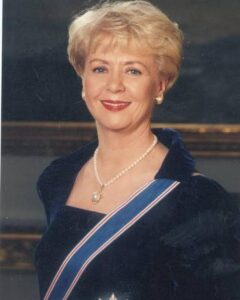
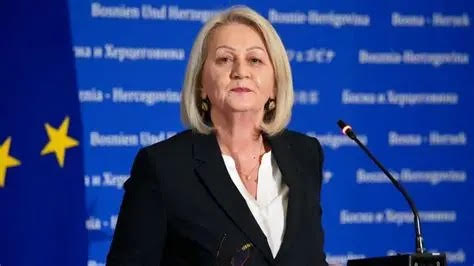
For decades, Bosnia and Herzegovina’s Council of Ministers had been led exclusively by men. That changed in January 2023 when Borjana Krišto, a lawyer from the small Herzegovinian town of Livno, became the first woman to chair the country’s government. Her appointment marked a historic breakthrough in a political landscape where women have long remained underrepresented in positions of executive power.
Born on 13 August 1961 in Livno, Krišto grew up in a town in the hills of Herzegovina, where her family had deep roots. She was born Borjana Krželj to Josip, popularly known as Jože, and Janja.
Her educational journey began with economics, graduating from high school in 1980. Four years later, she obtained a law degree from the University of Banja Luka. She subsequently passed the bar examination in Sarajevo and began working in the legal departments of several companies in Livno, including Agro Livno, Guber Livno, Likom Livno and Livno bus.
Those early professional experiences introduced her to the workings of businesses and institutions before she entered public service.
From Legal Practice to Political Leadership
In 1995, Krišto joined the Croatian Democratic Union of Bosnia and Herzegovina (HDZ BiH), beginning a political career that would eventually take her to some of the country’s highest public offices.
She steadily advanced within the party, serving as a cantonal justice minister and later joining its presidency. Between 2003 and 2007, she served as Minister of Justice of the Federation of Bosnia and Herzegovina, becoming the only woman in the federal cabinet for part of her tenure.
Her political career reached another milestone in 2007 when she became President of the Federation of Bosnia and Herzegovina, making her the first woman to occupy the position. She held the office until 2011.
Krišto subsequently served in both houses of the state parliament, gaining further legislative experience. In 2017, she became Speaker of the House of Representatives of Bosnia and Herzegovina, adding another significant leadership position to her political record.
Two Electoral Defeats Did Not End Her Ambition
Krišto’s journey to the country’s highest executive office was not without setbacks.
In 2010, she contested the Croat seat in Bosnia and Herzegovina’s tripartite Presidency but secured less than 20 per cent of the vote. Twelve years later, she entered the race again, receiving approximately 44 per cent but losing once more.
Despite two unsuccessful presidential campaigns, she remained active in politics and continued to pursue leadership opportunities.
In January 2023, she was appointed Chairwoman of the Council of Ministers of Bosnia and Herzegovina, becoming the first woman in the country’s history to lead the institution.
Her appointment represented a significant moment for women’s political representation. At her confirmation, Krišto acknowledged the responsibility attached to her position and expressed solidarity with women who continue to experience discrimination and inequality.
She also expressed pride in the achievements of women across the country, recognising the importance of their contributions to public life.
Advocating Greater Women’s Participation
Beyond her personal political achievements, Krišto has repeatedly spoken about the importance of women’s participation in leadership and decision-making.
In 2021, during a summit of women parliamentary speakers in Vienna, she argued that women should be recognised as a genuine force in democratic governance rather than treated as what she described as a “democratic decoration.”
On International Women’s Day in 2024, she used her position to encourage women across Bosnia and Herzegovina to become more actively involved in politics and public affairs.
She has also participated in initiatives addressing financial opportunities for women entrepreneurs, including conferences focused on improving access to financing for women-owned businesses.
However, her historic appointment has not eliminated the gender imbalance within the country’s political institutions. When her cabinet took office, only two of its members were women, highlighting the continuing gap between individual breakthroughs and broader political representation.
Her achievement therefore carries a wider significance: reaching the highest office is important, but ensuring that more women have access to leadership opportunities remains an unfinished task.
European Integration and Political Challenges
A major feature of Krišto’s tenure has been Bosnia and Herzegovina’s pursuit of membership in the European Union.
In March 2024, EU leaders agreed to open accession negotiations with the country, marking an important development in its European integration process.
Krišto welcomed the decision, describing the progress as “a huge step forward in terms of harmonizing our legislation with the European Union.”
However, her administration has also faced political disagreements and criticism. In 2023, she described Hamas’s attack on Israel as “unjust and brutal”, a position that attracted criticism from member of the country’s Presidency, Željko Komšić.
In 2025, disagreements over EU-related legislation contributed to tensions within the governing coalition, with a coalition partner withdrawing its support. Opposition parties subsequently called for her resignation and pushed for a no-confidence vote.
These challenges reflect the complicated political environment in which Krišto has had to exercise leadership, particularly in a country where governing arrangements involve multiple political and ethnic interests.
The Attack That Brought Politics to Her Doorstep
One of the most disturbing incidents in Krišto’s public life occurred in March 2017 at the entrance to her family home in Livno.
According to reports, a young man approached the property, verbally abused her and threw stones while she was standing in the courtyard. Krišto was not physically injured, and the police were notified shortly afterwards.
A 26-year-old student was detained on suspicion of endangering security.
Krišto described the incident as politically motivated. However, the suspect reportedly denied having a political motive, explaining that his actions were connected to media reports concerning donations to an association in Livno linked to her family.
Krišto maintained that she was not intimidated by the incident and would continue carrying out her responsibilities.
The available information does not establish the final judicial outcome of the case, leaving its legal conclusion unclear.
Maintaining Her Connections Beyond Government
Despite her responsibilities at the national level, Krišto has maintained strong connections with Livno, the town where her personal and professional journey began.
In April 2024, she participated in the opening of a business forum titled “Let’s Build Livno Together”, an initiative that brought together members of the diaspora and local entrepreneurs to explore opportunities for economic development.
The forum reflected her continued interest in the town’s development and the potential contribution of people living abroad to local businesses and investment.
Her public engagements have also extended beyond Bosnia and Herzegovina. In 2026, she participated in international diplomatic and political engagements, including the World Economic Forum in Davos, an audience with Pope Leo XIV at the Vatican, and a European People’s Party conference in Sarajevo.
She also held meetings with European officials, including EU foreign policy chief Kaja Kallas, and participated in the signing of a border crossings agreement with Croatian Prime Minister Andrej Plenković.
From her early legal career in Livno to becoming the first woman to chair Bosnia and Herzegovina’s Council of Ministers, Krišto’s political journey reflects decades of persistence, ambition and institutional experience.
Her two unsuccessful presidential campaigns did not end her political career. Instead, she continued through parliamentary and executive positions until she reached a level of leadership no woman in her country had previously occupied.
Her story is not simply about becoming the first woman to hold an office. It also raises a broader question about women’s access to political power and the opportunities available to those seeking to influence national decisions.
For women aspiring to leadership, Krišto’s journey demonstrates that electoral setbacks do not necessarily determine the limits of a political career. Her rise from Livno to the highest executive position in Bosnia and Herzegovina remains a significant chapter in the country’s political history.
By Umm e Habiba, Pakistan.