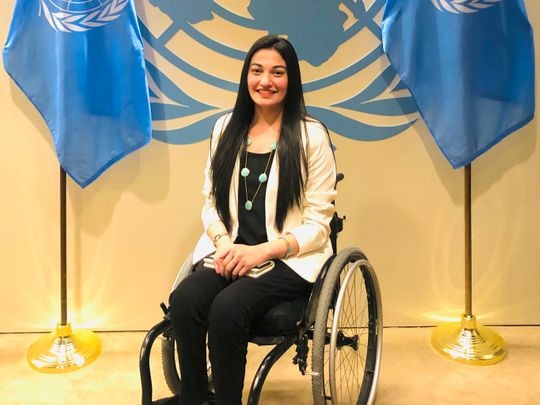
A wheelchair was supposed to mark the end of Muniba Mazari’s story. Instead, it became the seat from which she painted, spoke, hosted a national television show, and told millions that a body which stops working is not the same thing as a life that stops working. Nearly two decades later, the girl who was once told her future had ended is still the one writing it.
Muniba Mazari Baloch was born on March 3, 1987, in Rahim Yar Khan, a city in Pakistan’s southern Punjab province, into a conservative Baloch family. As a child, she dreamed of becoming an artist, but that dream was set aside early. At 18, in 2005, she married. She has said her father wanted her to marry, and she agreed because it would make him happy, even though, in her own words, it was never a happy marriage.
On February 27, 2008, Muniba was travelling with her husband from Quetta to Rahim Yar Khan when their car crashed. The injuries were catastrophic. Both bones in one arm were broken. Her rib cage, shoulder blade, and collarbone were shattered. Her spine sustained the most severe damage, leaving her paralysed from the waist down. After being moved between hospitals, she was admitted to Aga Khan University Hospital in Karachi, where she spent the next two years confined to a bed, unable to move much of her body.
Physiotherapy eventually gave her enough independence to use a wheelchair. But to many people around her, the wheelchair became the only thing they saw. She entered that car as a young wife with a future ahead of her. She left the hospital as a woman many assumed had none.
Her marriage did not survive the years that followed. She and her former husband have offered differing accounts of why the relationship ended, and their separation became public in a way she never sought. He later sued her for defamation over statements she made about their marriage, but the case was dismissed in January 2018. In 2011, before the marriage officially ended, the couple adopted a son, Nael, whom she went on to raise as a single mother.
Painting became her lifeline long before it became her profession. Confined to a hospital bed, with limited movement in her hands, she picked up a paintbrush to bring colour into days that had none. It was never just a hobby. It was survival. That instinct eventually grew into her art brand, Muniba’s Canvas, with the tagline, “Let Your Walls Wear Colours.”
Rebuilding her life meant accepting whatever work she could find. She managed Facebook pages to earn a living and taught Urdu through an educational initiative called Dheeray Bolo.
There was no dramatic comeback, only small opportunities embraced one after another by a woman determined to rebuild herself, piece by piece.
A TED Talk changed the direction of her life. It caught the attention of the managing director of Pakistan Television, who invited her to join the network. She went on to host the inspirational programme Mai Nahi Hum on Hum News, becoming Pakistan’s first wheelchair-using television anchor.
The fashion industry had never made space for someone like her, so she created her own. Pond’s named her its Miracle Woman, while Toni & Guy featured her as Asia’s first wheelchair-using model in its Women of Substance campaign.
Recognition followed, though it never erased the struggles behind it. In 2015, the BBC included her among its 100 Women, and the same year she became Pakistan’s first National Ambassador for UN Women. In 2016, Forbes named her to its 30 Under 30 Asia list. A year later, she travelled to Belgrade, Serbia, to receive the Karic Brothers Award for humanitarian service.
Her words have reached far more people than any title she has held. Three quotes, in particular, continue to resonate with audiences around the world:
“They saw my disability, I saw my ability.”
“Don’t let damage, caused by others, control your life.”
“When you accept yourself, the world recognizes you.”
Together, they capture the transformation she made—from being defined by what happened to her to defining what she would do next.
Muniba Mazari’s story is not one in which hardship simply disappeared. A marriage she entered for her father’s sake. A body forever changed by a devastating accident. A divorce played out under public scrutiny. None of it vanished. What changed was her refusal to let any of it have the final word.
She did not simply survive a car crash in 2008. She survived a marriage she did not truly choose for herself, a body that stopped cooperating, and a divorce that unfolded in headlines rather than privacy. Instead of disappearing beneath those burdens, she picked up a paintbrush, raised her son as a single mother, and built a life powerful enough to inspire people far beyond Pakistan’s borders.
By Umm e Habiba, Pakistan.