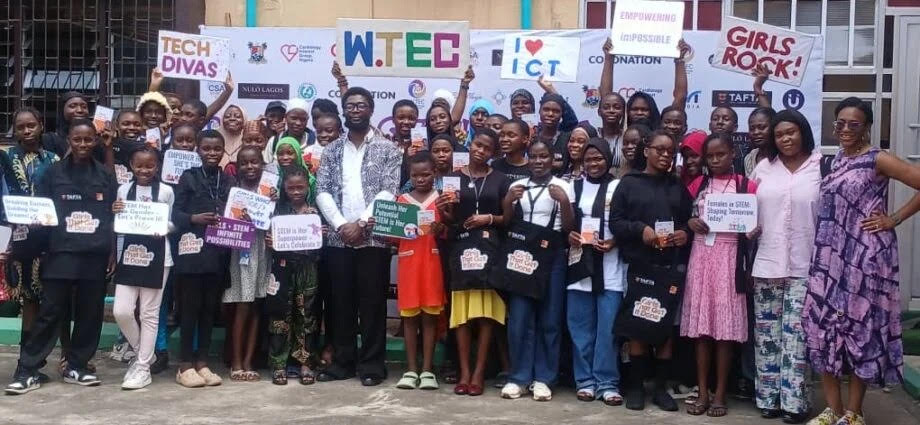
The Women’s Technology Empowerment Centre (W.TEC) is trying to change how Nigerian girls engage with technology—not simply by teaching them to use digital tools, but by giving them the skills and confidence to build with them.
Oreoluwa Lesi, W.TEC’s founder and Executive Director, outlined the organization’s approach in an interview with the News Agency of Nigeria on Thursday in Lagos, pointing to the organization’s 2026 She Creates Camp as a practical expression of that mission.
The shift is evident in this year’s curriculum, which places artificial intelligence at the centre while incorporating cybersecurity, content creation, filmmaking and electronics. The mix marks a noticeable expansion from previous editions of the camp.
“This year our focus is AI, but the curriculum has really changed from last year. There is a lot more content creation and using AI to support generating scripts,” Lesi said.
Participants are also being taught how to apply AI to filmmaking, while the camp emphasizes hands-on projects that require the girls to turn ideas into tangible outcomes.
For Lesi, that practical approach is essential. Rather than simply learning what technology can do, she wants participants to experiment with it and understand how it can be applied to problems in their own communities.
Cybersecurity has also become part of the curriculum as more children begin using the internet at younger ages.
“Especially when people are going online at a younger age now, it is very important to make sure they are able to use the internet safely and wisely,” she said.
The training is part of W.TEC’s broader effort to close the gender gap in technology.
Lesi said the organization’s goal is to increase the number of women who participate in creating and shaping the technologies that increasingly influence everyday life. That mission has expanded beyond technology itself to include science, engineering and mathematics.
She pointed to the continued underrepresentation of women across STEM fields, including emerging areas such as artificial intelligence, and warned that the consequences go beyond employment figures.
“If women are not participating in this space, we are being left behind and we are not having any influence on creating and shaping the technologies we are going to use,” she said.
For W.TEC, the objective is therefore not merely to introduce girls to STEM, but to help them see those fields as tools they can use to address problems around them.
The She Creates Camp runs as a two-week residential programme combining technical training with excursions, leadership development and other activities designed to broaden participants’ experience.
Lesi said the transformation is often visible from the beginning of the programme to graduation.
“By the time you see a girl on her first day and then see her on graduation day, there will always be a change,” she said.
One element W.TEC considers important to that transformation is the girls-only environment.
Lesi said girls can sometimes withdraw from mixed learning environments when boys dominate access to equipment or take the lead in practical activities. A girls-only setting, she argued, gives participants greater freedom to experiment and participate.
“There is something about having a space that is just girls only. They are free in a way that they may not be if there are boys around,” she said.
The challenge is not only access to equipment. It is also the persistence of stereotypes that portray boys as naturally more capable in science and technology.
Changing those attitudes, Lesi acknowledged, requires more than a two-week camp.
“It is a whole ecosystem of work. The work we do here with the girls is just one part of it,” she said.
Access remains central to the programme.
This year’s 43 participants were largely supported through corporate and private sponsorships. LTT Marine and Coastal Services sponsored 20 girls from communities around Tincan Island and Apapa, while Alaro City sponsored 18 participants from Epe.
Many of the participants come from public schools where access to functioning technology facilities remains limited.
“These are girls who would not normally have access to this kind of opportunity in their schools,” Lesi said.
Yemi Odutola, W.TEC’s Media Liaison Manager, said the 2026 edition, with more than 40 participants, represents a recovery from the decline in participation during the COVID-19 pandemic.
He also noted that the camp expanded to Ondo State for the first time this year and returned to Kwara State after an earlier edition there.
The increased emphasis on artificial intelligence, he said, reflects changes already taking place in the labour market.
“The girls are aware that they have to step up in AI and digital skills. They also understand that many jobs available today may not exist very soon,” Odutola said.
For some participants, the impact extends beyond the technical skills acquired during the camp.
Favour Edem, who attended the programme in 2024 and now volunteers with W.TEC, said the lessons she learned about sustainability, leadership and relationships have continued to influence her.
“Most of the things I learned two years ago are still with me. The experience from the camp is something that will stay with me for a very long time,” she said.
Deborah Adilo, a student of Badagry Senior High School and participant in this year’s camp, arrived with doubts about whether technology was a space for her as an arts student.
The camp changed that perception by showing her how technology could intersect with creativity, art and business.
“I learnt that we cannot use AI for just one specific thing. AI takes us to a whole different aspect of life, based on what you want it to do,” she said.
Creating videos with AI was among the experiences that stood out for her and left her eager to explore the technology further.
For W.TEC, that curiosity is part of the point.
The aim is not simply to produce girls who know how to operate the technologies already around them, but a generation confident enough to question, create and shape what comes next.
Umm E Habiba, Punjab, Pakistan.