Nigeria and the Republic of Korea have reaffirmed their commitment to strengthening bilateral relations, with both countries identifying trade, technology, agriculture, manufacturing and human capacity development as key areas for deeper cooperation.
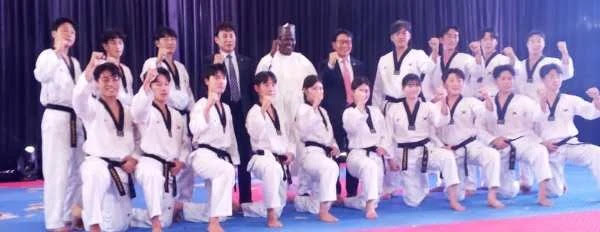
The commitment was highlighted at Korea’s National Day reception in Abuja on Friday night, where a 16-member demonstration team from Kukkiwon, the world headquarters of taekwondo, performed to close the event.
Organized by the Korean Cultural Centre Nigeria (KCCN), the reception brought together government officials, diplomats and other stakeholders to celebrate the longstanding relationship between the two countries, according to the News Agency of Nigeria (NAN).
Speaking at the event, Korean Ambassador to Nigeria, Jeong Yo-an, said his country remained committed to supporting job creation and promoting investment in Nigeria through Korean companies operating in sectors such as energy, manufacturing and digital technology.
He identified Daewoo E&C, LG, Samsung, Hyundai and Solpia as some of the companies contributing to economic cooperation between the two countries through employment generation, knowledge sharing and business opportunities.
The ambassador said the Korean Embassy, in collaboration with the Korea Trade-Investment Promotion Agency (KOTRA), would continue to promote investment, technology transfer and local employment.
“Together, we aim to create jobs, share knowledge and expand opportunities for both countries, as well as turning potential into opportunity and opportunity into shared prosperity,” he said.
Nigeria’s Minister of Foreign Affairs, Amb. Bianca Odumegwu-Ojukwu, represented by the ministry’s Chief of Protocol, Amb. Babagana Wakil, described the reception as an opportunity to celebrate the longstanding friendship between Nigeria and Korea and strengthen their bilateral relationship.
She said the two countries had sustained cordial relations through high-level engagements, mutual cooperation and joint efforts on issues of common interest.
“Nigeria and the Republic of Korea have continued to collaborate on multilateral platforms in promoting international peace, security and sustainable development. Both countries share a commitment to constructive dialogue and cooperation in addressing global challenges,” she said.
The minister noted that Korea’s achievements in industrialization, technology, manufacturing and infrastructure development offered valuable lessons for Nigeria’s own economic growth.
Trade and Investment Opportunities
On trade and investment, Odumegwu-Ojukwu said both countries had maintained mutually beneficial relations, particularly in the energy, industrial and technology sectors.
“In the area of trade and investment, both countries have maintained mutually beneficial relationships, particularly in energy sector, industrial, and technology,” she observed.
She said there was considerable potential to expand trade beyond crude oil and liquefied natural gas, encouraging increased exports of non-oil products, including agricultural produce.
“Nigeria also welcomes increased Korean investment in manufacturing, automobile assembly, shipbuilding, and other productive sectors that can promote technology, transfer and employment generation,” she said.
Agriculture was another area she identified for stronger cooperation, particularly in mechanization, rice production, agro-processing and food security.
“In agriculture, Nigeria is interested in benefiting from Korea’s expertise in mechanisation, improved rice production, agro-processing and strengthening food security and agricultural productivity,” she emphasised.
She also reaffirmed Nigeria’s interest in exploring opportunities to participate in Korea’s K-Rice Belt Initiative.
The minister further called for expanded cooperation in education, digital technology, technical training, scholarships, academic exchanges and research partnerships to equip young people and Nigeria’s workforce with relevant skills.
“Nigeria and Korea also continue to develop more opportunities to deepen cooperation in education, digital technology, human capacity development, true scholarship, technical aid training, academic exchange, and research partnership,” she said.
She identified maritime security, shipbuilding, fisheries and technical capacity development as additional areas requiring greater collaboration.
Odumegwu-Ojukwu also stressed the importance of the Nigeria-Korea Joint Commission as a framework for advancing bilateral cooperation.
She concluded by expressing Nigeria’s appreciation for Korea’s contributions to the country’s development.
“The Government of Nigeria appreciates profoundly this great support and contribution of the Government and good people of Korea to the growth and development of Nigeria,” she said.
Cultural Exchange Strengthens Bilateral Relations
In his remarks, Ambassador Jeong Yo-an said diplomatic relations between Nigeria and Korea began in 1980 and had continued to grow through cooperation, mutual respect and people-to-people exchanges.
He praised Nigeria’s history, cultural diversity and young population, describing its people as talented and energetic.
“We respect Nigeria’s own vision for its future and we are proud to work together as equal partners. We know we did not come with all the answers, but we came as friends and partners, ready to share, learn and grow together,” he said.
The ambassador noted that the relationship extended beyond business and development to cultural exchange, with Nigerian audiences embracing Korean entertainment and lifestyle trends, including K-pop, Korean dramas, films and K-beauty.
He also highlighted Korea’s appreciation of Nigeria’s creative industries, particularly Afrobeats and Nollywood.
“We also admire Nigeria’s creativity, especially Afrobeats and Nollywood. From K-pop to Afrobeats and Korean dramas to Nollywood, these shared creative forces bring our cultures closer together,” he said.
He urged both countries to sustain mutual respect and celebrate their cultural differences while building a stronger partnership.
“Let us respect our differences, celebrate our friendship and build a better future together,” he advised.
Reflecting on Korea’s history, Yo-an expressed gratitude to countries and people who supported the nation during difficult periods.
“We remain deeply grateful to the countries and people who stood with Korea during those difficult years. Korea’s experience reminds us how much we can achieve when people and nations support one another,” he said.
Korea Celebrates Its National Foundation Day
The reception also commemorated Korea’s National Foundation Day, known as Gaecheonjeol, celebrated annually on October 3.
The national holiday marks the legendary founding of Gojoseon, regarded as Korea’s first kingdom, by Dangun Wanggeom in 2333 BC. It symbolizes the beginning of the Korean people and their civilization.
Explaining the historical significance of the celebration, Ambassador Yo-an said Korean tradition traced the nation’s founding story back more than 4,000 years to Dangun.
“According to this tradition, Dangun’s founding vision was ‘Hongik Ingan’ which simply mean ‘to benefit all humanity’,” he explained.
He said the principle had been passed down through generations and continued to influence Korean society.
“This spirit has been passed down from generation to generation for thousands of years and it remains alive in Korea today,” he said.
For him, the philosophy serves as a reminder of the importance of caring for others, respecting individuals and contributing to the common good.
“For us, it is a reminder to care for one another, respect every person and contribute to the well-being of others,” he added.
He described the Nigeria-Korea relationship as a reflection of the same philosophy, built around mutual benefit and shared progress.
“For me, this partnership reflects the spirit of ‘Hongik Ingan’ working together for mutual benefit,” he said.
The ambassador concluded by celebrating both Korea’s National Day and the enduring friendship between the two countries.
“Tonight we celebrate not only Korea’s National Day, but also the friendship and cooperation that bring us together, as well as Korea’s achievements,” he said.
He also expressed appreciation to the Nigerian Government and people, members of the diplomatic community, United Nations partners and other friends for their continued support.
By Umm e Habiba Pakistan