

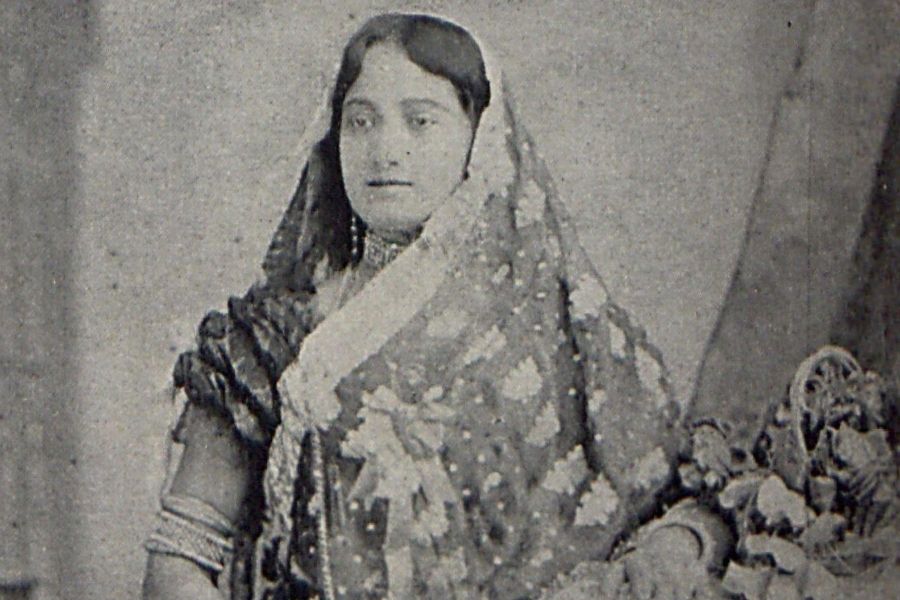
A girl forced onto a stage at thirteen. Blessed by India’s holiest man at twenty. Betrayed and erased at twenty-five. This is the untold story of Binodini Dasi, a woman who defied fate and society.
At just 13, Binodini Dasi stood backstage at the National Theatre in Kolkata, terrified. Born around 1863 in a suburb of Kolkata into crushing poverty, Binodini’s early life was shaped by the harsh realities of the courtesan (dasi) system, where women were trained in the arts as part of social survival.
Her autobiography reflects that she came from a family associated with prostitution, a reality she later described with unvarnished honesty.
At just 13 or 14, Binodini made her stage debut in December 1874 at the Great National Theatre in Calcutta with a minor role — a start that launched her extraordinary journey in Indian theatre. At that time, women performing publicly was controversial, and the stage was dominated by male actors; many roles for women were traditionally played by men.
Almost immediately, her emotional depth, versatility, and commanding presence captivated audiences. In a career that would span about 12 years, she portrayed more than 80 roles in over 50 plays, including iconic portrayals of mythological and historical characters such as Sita, Draupadi, and Radha.
By 1883, her popularity was such that she and her mentor, Girish Chandra Ghosh, were central to the establishment of the Star Theatre in Kolkata, funded by patrons including Gurmukh Rai. While records describe complex negotiations around finances and social conventions, Binodini’s star power was undeniable.
One of her most remarkable public moments came during her performance in Chaitanyaleela, a play about the saint Chaitanya Mahaprabhu.
The great Bengali mystic Ramakrishna Paramahamsa attended the performance and was reportedly moved such that he came forward and blessed her on stage — a scene that shocked orthodox society and signalled the spiritual and artistic power of her craft.
Despite her success, Binodini faced relentless social stigma. The same patriarchal society that lauded her talent resisted giving her full recognition: the theatre she helped make successful was named the “Star Theatre” rather than after her.
Social hostility, professional jealousy, and the rigid norms of Victorian-era Bengali society contributed to her early departure from the stage. She retired from public theatre around 1886–1887, at about 23–25 years old.
After leaving the stage, Binodini occasionally worked as a singer, including recording with the Gramophone Company, but she never regained her theatrical prominence.
Her autobiography, Amar Katha (My Story), published in 1912–1913, remains one of the earliest South Asian memoirs by an actress. In it, she detailed not only her achievements but also the exploitation, betrayal, and hypocrisy she faced — narrating her life with candour and rare self-awareness.
Binodini Dasi died on 12 February 1941 in Calcutta at approximately 78 years of age. For decades she was largely forgotten, but later scholars and theatre practitioners rediscovered her work, recognising her contributions to Bengali theatre, women’s visibility in performing arts, and autobiographical literature.
In recent years, her legacy has been formally honoured: Kolkata’s Star Theatre was renamed Binodini Theatre to acknowledge her foundational role in Bengali theatre history.
Today, Binodini is celebrated as a pioneering actress and trailblazer, whose life challenged social conventions and redefined what women could achieve on the stage. Plays, films, and scholarship continue to explore her legacy, ensuring her story endures.
Umm E Habiba
Punjab, Pakistan.