Kahina: The Queen Who Defied an Empire
In 690 CE, the Islamic Caliphate pushed westward into North Africa after conquering Arabia, Egypt, and Mesopotamia. Arab commanders expected the Maghreb stretching from Libya to Morocco to fall quickly. Instead, they encountered resistance led by a woman known as Kahina.
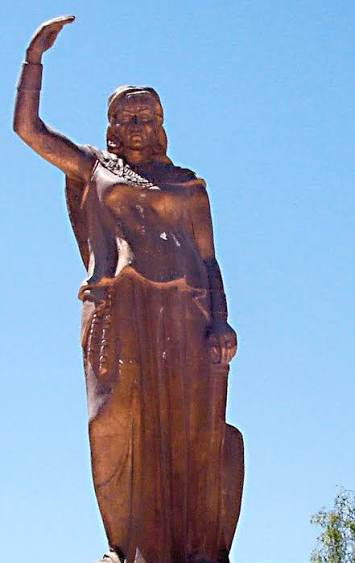
Her name meant “seer” or “prophetess,” and it would come to symbolize defiance. Rather than surrender her land, she chose to burn it. For five years, she halted the advance of one of the most powerful empires of the age.
Kahina emerged from the Aurès Mountains in what is now Algeria, a region of jagged peaks, narrow passes, and natural defenses. She was not born into conventional royalty.
Among the Berbers, leadership was earned, not inherited, and Kahina rose through spiritual authority and military intelligence at a moment when her people faced collapse.
Arab chroniclers, writing decades or centuries later, described her as tall, dark-skinned, and wild-haired. They labeled her a sorceress who could foresee the future and commune with hidden forces. Whether she truly claimed prophetic visions or simply possessed exceptional strategic insight remains unclear. What mattered was that her people believed she could see what was coming and that belief made her powerful.
When the Arab general Hassan ibn al-Nu‘man arrived around 690 CE with a large army, Berber tribes were offered a choice: submit, convert to Islam, or be conquered. Kahina proposed a third path resistance.
She accomplished what few had managed before her: uniting deeply divided Berber tribes. Differences in language, territory, and long-standing rivalries were set aside. This unity required more than battlefield skill; it demanded spiritual legitimacy that transcended tribal boundaries, which Kahina uniquely possessed.
Fire, Resistance, and Legacy
The first major clash occurred near the Meskiana River. Hassan’s forces had superior numbers and equipment, and the confidence of an army that had conquered half the known world. Kahina countered with terrain and strategy.
Using guerrilla warfare, ambushes, and calculated retreats, she drew Arab troops into mountainous terrain where their numbers became a liability. Her fighters knew every canyon and hidden path. Hassan’s army was devastated, and he narrowly escaped, retreating to Libya and warning the Caliph that the Maghreb would not fall easily.
For the next five years, Kahina effectively ruled much of North Africa. During that time, the Caliphate stretching from Spain to India was unable to advance westward. Yet Kahina understood that this stalemate could not last. Reinforcements would keep coming, and the empire’s resources far exceeded her own.
Faced with this reality, she made a decision that would divide her people and define her legacy. Kahina chose to burn her own land. Cities were destroyed, crops set ablaze, and orchards laid waste so that the conquerors would inherit nothing of value.
To many of her supporters, this strategy became unbearable. Urban populations watched their homes and livelihoods disappear. Tribes that had backed her in hope of victory began to doubt a leader willing to destroy the present to protect the future. Arab chroniclers later portrayed this as madness, but Kahina likely saw it as the only way to prevent cultural erasure under conquest.
Around 698 CE, Hassan ibn al-Nu‘man returned with fresh troops and a population no longer united behind its queen. The final battle took place near a well in the Aurès Mountains. Sources differ on the details, but all agree on the outcome: Kahina died fighting. Some accounts say she was killed in battle; others claim she took poison rather than be captured.
One version of the story states that before the final confrontation, Kahina sent her sons to Hassan, instructing them to convert to Islam and survive. Her war was ending, but their lives did not have to end with hers.
Her sons did convert and later served as officers in the Arab army, helping to conquer the very lands their mother had defended. Whether this was betrayal, pragmatism, or obedience to her final command remains unknown. History, written by the victors, offers no clear answer.
Kahina’s religious identity is also disputed. Some Arab sources described her as a Jewish Berber, reflecting the presence of Jewish communities in North Africa at the time. Other accounts suggest she practiced indigenous Berber beliefs influenced by Christianity. Many modern scholars argue that labeling her as Jewish was a later attempt to delegitimize her resistance by portraying her as a religious outsider. The truth likely died with her.
What survived was her memory. Across centuries, Kahina became a symbol of resistance for the Berber people. Although North Africa was transformed by Arab-Islamic conquest, Berber languages, traditions, and identity endured sometimes hidden, sometimes openly defiant.
In the 20th century, her story resurfaced during anti-colonial struggles. Algerian nationalists and Berber rights movements embraced her as proof of a long history of resistance and cultural survival.
Kahina lost the war. Her kingdom burned. Her sons joined the enemy. The empire she resisted conquered her land. Yet that empire collapsed centuries ago, while the people she fought for remain.
Millions still speak Berber languages across North Africa. Their culture persists changed, adapted, but unbroken. And in that survival lies Kahina’s victory.
She was the queen who chose destruction over surrender, who believed that preserving a people’s soul sometimes demands sacrificing everything else. For five years, she stopped an empire. And long after that empire vanished, her name endured.
Umm E Habiba
Punjab, Pakistan