


Across cultures, history, and generations, one pattern remains strikingly consistent. Women are often judged more harshly than men for similar behaviors, choices, and even mistakes. Whether it is appearance, relationships, ambition, morality, or public behavior, the standards applied to women tend to be stricter, more emotional, and less forgiving. Understanding this imbalance requires looking at history, culture, social expectations, and how gender roles were constructed over time.
At the foundation of this issue is the historical structure of society itself. For centuries, many societies were built around patriarchal systems where men held most of the power in politics, religion, education, and economics.
In such systems, women were often assigned specific roles tied to home, family, and obedience. Even though modern society has changed significantly, many of these old expectations still influence how people think today.
As a result, women are often judged not only for what they do, but for how well they conform to long standing expectations of femininity.
One of the clearest examples of this double standard is in appearance. Women are often expected to maintain a high standard of physical presentation at all times.
They are judged for being “too dressed up” or “not dressed well enough,” “too slim” or “not slim enough,” “too expressive” or “not modest enough.” Men, on the other hand, are generally given more freedom to appear as they wish without intense public scrutiny.
This creates a constant pressure for women to manage not only their lives but also how they are perceived visually.
The Nigerian author Chimamanda Ngozi Adichie once observed in her feminist discussions that gender expectations are often deeply rooted in social conditioning, not biological differences. This idea helps explain why society reacts differently to the same behavior depending on whether it is performed by a man or a woman.
Another area where judgment is heavily uneven is relationships and sexuality. Women are often judged more strictly for their relationship choices, number of partners, or even how they express affection. A man with multiple relationships may be socially praised or excused, while a woman may face criticism or labeling. This creates a moral imbalance where women carry a heavier burden of reputation management in personal life.
There is a well known African proverb that says, “When a man is seen with many keys, he is a master; when a woman is seen with many keys, she is careless.” While not universally true, this reflects how societies often interpret the same behavior through different moral lenses depending on gender.
Public behavior and emotional expression are also judged differently. When women are assertive, they may be labeled as “aggressive” or “difficult.” When men display the same assertiveness, it is often interpreted as leadership or confidence. Similarly, when women express emotion, they may be called “too sensitive,” while men expressing the same emotion may be told they are “weak.” This creates a narrow emotional space where women are expected to be composed but not “too much” of anything.
Work and ambition also reveal this imbalance. A successful woman may face more questions about how she balances work and family, while a successful man is less likely to face the same scrutiny. Women in leadership positions are often judged not only on performance but also on personality, tone, and appearance. This creates what many scholars describe as an “extra layer of evaluation” that men are less likely to experience.
The American writer Audre Lorde once said, “I am not free while any woman is unfree, even when her shackles are very different from my own.” This reflects how deeply interconnected gender expectations are, even when they appear subtle or normalized in daily life.
Social media has further intensified these judgments. Women today are not only judged in their immediate communities but also by a global audience. A single photo or video can attract thousands of opinions, many of which focus on appearance, morality, or lifestyle choices. The speed and scale of online judgment make it even more intense than traditional forms of social scrutiny.
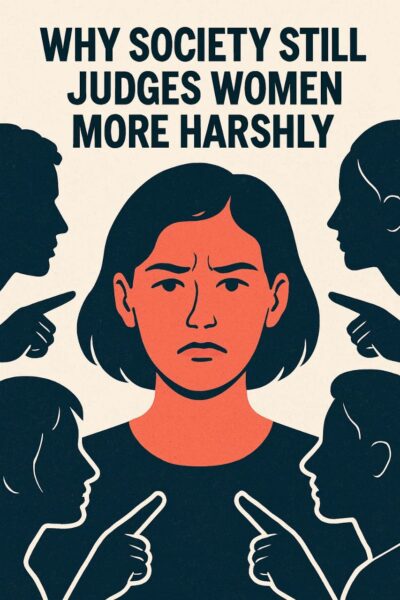
Another reason women are judged more harshly is social conditioning. From childhood, many societies teach girls to be “careful,” “polite,” “modest,” and “acceptable,” while boys are often encouraged to be “bold,” “adventurous,” and “confident.” Over time, these expectations become normalized, and people unconsciously carry them into adulthood. This is how bias becomes invisible yet powerful.
Religion and culture also play a role. In many traditional settings, women are often seen as symbols of family honor or cultural values. As a result, their behavior is not just seen as personal but as representative of their family or community. This creates additional pressure and judgment that men are less likely to experience in the same way.
However, it is important to note that society is not static. There is growing awareness and resistance against these double standards. Feminist movements, education, and global conversations are challenging outdated norms and encouraging more balanced evaluations of men and women. Young people today are increasingly questioning why such differences exist and whether they are justified.
At the same time, change is not automatic. Deeply rooted beliefs take time to shift. Even in modern environments, subtle bias still exists in language, expectations, and everyday interactions. Recognizing these patterns is the first step toward addressing them.
In conclusion, society judges women more harshly than men due to a combination of historical structures, cultural expectations, social conditioning, and ongoing bias. These judgments appear in appearance, behavior, relationships, work, and even emotional expression. While progress is being made, the imbalance still exists in many forms.
True fairness requires more than equality in words. It requires awareness of bias, willingness to challenge double standards, and the creation of social spaces where individuals are judged by their actions and character rather than gendered expectations.
By Almustapha Bishir Jume