
Long before the world knew her name, she was just a young girl standing under the wide Kaduna sky, watching aircraft roar above her with wonder in her eyes. While others saw noise and motion, she saw purpose. While others watched them pass, she imagined herself inside the cockpit, steady hands on the controls, serving something greater than herself.
For Tolulope Arotile, the sky was never distant. It was personal.
She grew up with quiet determination, the kind that does not announce itself loudly but burns steadily within. In a society where combat aviation was long considered a male domain, her dream required more than ambition; it required courage. Not the dramatic kind displayed in battle, but the everyday courage to believe she belonged in spaces where no women had stood before.
Born on 13 December 1996 in Kaduna State, Tolulope Arotile was the youngest child to grow up in a disciplined and supportive family that values education, integrity, and service. She was described as respectful, focused, and quietly ambitious. From an early age, she excelled academically and demonstrated unusual determination.
She attended Air Force Primary School, Kaduna, from 2000 to 2005, and continued at the same Air Force Secondary School, Kaduna, from 2006 to 2011.
These formative years grounded her in military culture and discipline from a young age. Even as a student, she stood out for discipline, intelligence, and leadership. What began as admiration for aircraft gradually matured into a clearly defined career objective.
In 2011, Nigeria made a historic change: women were allowed into combatant training at the Nigerian Defence Academy for the first time. This reform opened doors that had long been closed to female officers, and Tolulope seized the opportunity.
She underwent mentally, physically, and emotionally intensive training alongside others. The standards she and other girls met were the same as those of their male counterparts. Tolulope did so with excellence, focus, and resolve.
Her training at the NDA (Nigerian Defence Academy) was rigorous, academically demanding, physically intense, and psychologically exacting. She did not simply train to pass examinations; she prepared to carry responsibility in one of the nation’s most sensitive security roles.
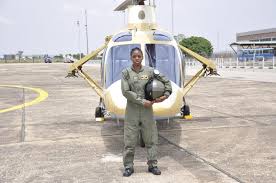
In September 2017, she was commissioned into the Nigerian Air Force as a Flying Officer. Her journey was just beginning.
She underwent advanced helicopter training abroad, first at the Starlite International Training Academy in South Africa, and later in Italy on the Agusta 109 Power Attack Helicopter, preparing her for complex combat missions.
Alongside these courses, she earned a commercial pilot license, further sharpening her skills and operational readiness for high-stakes deployments.
In October 2019, she achieved a historic milestone when she was decorated as Nigeria’s first-ever female combat helicopter pilot.
Tolulope accepted this not as a moment of personal triumph but as a professional responsibility and institutional transformation.
And she proved it in action.
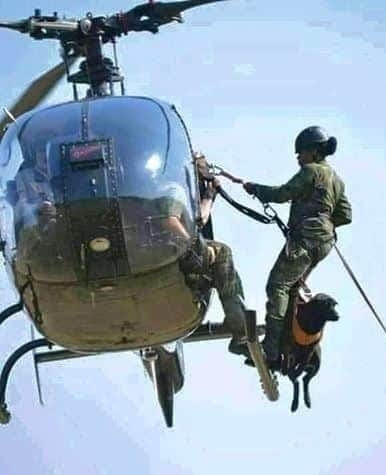
She was deployed in active combat and surveillance missions across Northern Nigeria, contributing to counter-insurgency and anti-banditry operations against Boko Haram and other armed groups, including factions affiliated with the Islamic State (ISWAP).
Within roughly two years of operational service, she accumulated over 460 flight hours in helicopters, a remarkable achievement for a young combat pilot operating in high-threat environments. These were not routine flights. They involved tactical coordination, aerial reconnaissance, and direct support for ground operations.
Her superiors commended her professionalism, calm decision-making, and technical precision. She was not regarded merely as a symbolic figure; she was operationally effective. But her impact extended far beyond the cockpit.
Tolulope Arotile became a living representation of possibility as:
- She symbolized gender inclusion within Nigeria’s armed forces.
- She challenged long-standing assumptions about women in combat aviation.
- She inspired a generation of young girls to pursue careers in STEM, aviation, engineering, and national service.
Her presence reshaped public perception not through speeches, but through performance.
Then, on 14 July 2020, at only 23 years old, her promising journey was tragically cut short after she sustained fatal injuries from being inadvertently struck by a vehicle driven by a former Air Force Secondary School classmate at the Kaduna Air Force Base. Despite urgent medical attention, she succumbed to her injuries.
The news sent shockwaves across Nigeria.
Military leaders, government officials, civil society organizations, and ordinary citizens mourned her loss. For many, it felt as though the nation had lost not just an officer but a symbol of forward movement.
In 2021, she was posthumously honoured at the Royal African Young Leadership Forum (RAYL) by Oba Adeyeye Ogunwusi, the Ooni of Ife, in recognition of her courage and sacrifice. Memorial initiatives and recognitions were established in her name, ensuring that her legacy would endure institutionally and culturally.
Tolulope Arotile’s life was brief, but it was consequential.
She transformed policy reform into a lived reality. She turned opportunity into excellence. She proved that history can be rewritten by those bold enough to claim their place in it.
Today, when young Nigerian girls look toward the sky and imagine themselves in uniform, commanding aircraft, defending their nation, they are not imagining the impossible. They are following the path she carved.
Today, Tolulope Arotile’s legacy continues to elevate minds while her courage remains a standard of service to the country. And because of her, young Nigerian girls can dream of the skies too.
Umm E Habiba
Punjab, Pkaistan