

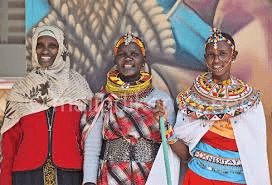
On Kenya’s Wasini Island, where climate change once devastated livelihoods, families, and the environment, a determined group of women has emerged as the driving force behind a remarkable transformation. Their efforts have not only restored damaged ecosystems but have also rebuilt the social and economic fabric of their community.
Wasini Island, located 53 miles south of Mombasa and home to about 3,000 people, has for decades borne the brunt of climate change. Rising ocean temperatures and sea levels triggered widespread coral bleaching, destroying critical marine habitats. According to a 2013 survey by the Kenya Marine and Fisheries Research Institute (KMFRI), between 60 and 90 percent of the island’s coral reefs were lost.
The destruction of these reefs led to declining fish stocks and a collapse in tourism, the two main sources of income for residents. As livelihoods disappeared, the crisis rippled through the community. Families struggled to survive, children dropped out of school, and cases of drug abuse among men and youth increased. Domestic conflicts also rose as financial pressures intensified.
One of those affected was 46-year-old Aisha Mohamed, a mother of three, who was forced to leave her husband after his inability to provide led to violence. “It reached a point where he could no longer provide for the family. He became violent, and that is when I chose to walk away for the sake of my children’s safety.”
Fishermen also faced harsh realities. Ali Noor, a 34-year-old fisherman, recalled,
“There were times we would spend the entire night at sea and return with almost empty nets.” As fish stocks declined, many were forced to leave the island in search of alternative opportunities.
Amid this crisis, the women of Wasini Island stepped forward to lead change. With support from KMFRI, the Coastal Development Authority, and the National Environment Management Authority, they launched a coral restoration initiative aimed at reviving the damaged marine ecosystem.
The women were trained to produce artificial corals using locally available materials such as shoreline rock boulders and hydraulic cement. These corals are first raised in nurseries managed by the women for three weeks before being transplanted into selected ocean areas. The results have been promising, with a reported survival rate of 75 percent.
Marine researcher Dr. James Kairu described the initiative as a success beyond expectations.
“The involvement of the community in the project has worked beyond our expectations. This project has breathed life back into the sustainable livelihoods of the Wasini people.”
Further highlighting the impact, KMFRI’s Jelvas Mwaura noted,
“The transplanted corals have provided new habitats for marine species. Fish populations in waters around the island have increased threefold compared to other areas.” Since 2018, the women have cultivated more than 3,000 corals along a 1.2-kilometer stretch.
The restoration of coral reefs has also revived tourism. Ecology scientist Nicholas Murage explained, “The project has led to an increase of up to 80 percent in ecotourism, up from 30 percent in 2013.” Visitors are now returning to witness the rejuvenated marine ecosystem.
For the women involved, the project has created new opportunities and transformed lives. Umar Noordin, 46, who joined the initiative in 2018, said, “Through this project, women have created new sources of income through tour guiding, fish trading, and running restaurants.” She added that family life has improved significantly. “Women are now supporting their households, which has reduced cases of domestic violence.”
Rehema Musa, a single mother of three, also shared her experience. “Fishing has improved as a result of coral restoration. I now buy fish from fishermen and sell them on the mainland. This has enabled me to take care of my children.” She added, “With this income, I can comfortably pay for their school fees, clothing, and medical needs.”
Tourism has also opened doors for younger women. Hubah Balack, 26, a tour guide, said, “With tourists coming to see the restored corals, ecotourism has become a reliable source of income. It is putting money into our pockets.”
Building on their success, the women expanded their efforts to include mangrove restoration. Mangroves had been heavily depleted due to illegal logging and charcoal burning, worsening coral degradation by increasing sedimentation. In response, the women established nurseries and have planted approximately 170,000 mangrove seedlings across the island.
Dr. Kairu emphasized their importance, stating, “Mangroves help stabilize the coastline and reduce the impact of rising sea levels.”
The project’s impact has gained widespread recognition. Mohamed Keinan, Managing Director of the Coast Development Authority, said, “The initiative has restored marine biodiversity and improved food security, which was once a major challenge for the community.”
The initiative has also helped individuals rebuild their lives. Said Abdallah, 30, a recovering drug addict, shared, “I was unable to provide for my family, and my wife left me.” Now working with the project, he earns a steady income from fishing and has rebuilt his life.
Today, the project directly employs about 230 women who work as tour guides, divers, conservationists, fish traders, and restaurant operators.
Swabrah Mohamed Ahmed, the 42-year-old chairperson of the Wasini Women Group, highlighted additional benefits. “We have reduced maternal deaths by providing boats that serve as emergency transport for women in need of medical care.” She added, “Drug abuse has significantly declined, as most young people are now engaged in income-generating activities.”
The success of Wasini Island is now serving as a model for other regions. The Coast Development Authority has extended this approach to Pate Island in Lamu, using lessons learned to guide broader conservation efforts along Kenya’s coastline.
What began as a climate crisis has evolved into a powerful story of resilience. At the heart of this transformation are the women of Wasini Island, whose determination has restored their environment, revived their economy, and brought stability back to their community.
Umm E Habiba,
Punjab, Pakistan.