
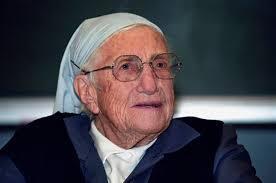
There are lives that pass quietly through history, and then there are lives that leave behind a question so profound that the world cannot remain unchanged by them. Sister Emmanuelle lived such a life. Not because she sought recognition, but because she made a choice most people spend their entire lives avoiding. She chose to walk toward suffering when she could have comfortably walked away.
Born in 1908 as Madeleine Cinquin, her story began in Brussels, where she was raised in a cultured and intellectually rich environment. Her early education reflected discipline, curiosity, and a deep love for learning. By the late 1920s, she had pursued higher studies in literature and philosophy at the Sorbonne in Paris. In 1929, she formally joined the religious order that would shape her spiritual journey, marking the beginning of a life devoted not only to knowledge, but also to service.
Her academic background soon blossomed into a long and respected teaching career. From the early 1930s through the late 1960s, she taught literature in countries such as Turkey, Tunisia, and Egypt. For nearly four decades, her classrooms were filled with students from privileged families, particularly the daughters of diplomats. It was a life marked by intellectual engagement, cultural refinement, and stability.
Yet, over time, a quiet question began to grow within her:
Was knowledge enough if it never reached those who needed it most?
In 1971, at the age of sixty three, she made a decision that would completely redefine her life. She asked where the poorest people in Egypt lived. The answer led her to the garbage settlements of Moqattam in Cairo, where tens of thousands survived by sorting through the city’s waste. That same year, she moved into the settlement.
What followed was not a temporary mission, but a lifelong commitment that endured for more than twenty years.
Living in a small and simple room built by the community, she immersed herself fully in their reality. Drawing from her decades of teaching experience, she began educating children who had never stepped into a classroom. She treated wounds, offered comfort, and became a trusted presence among families who had long been neglected by society.
What distinguished Sister Emmanuelle was her understanding of poverty. She rejected the belief that people were poor because they lacked effort. Instead, she saw poverty as the consequence of systemic neglect, inequality, and indifference.
In 1980, she founded ASMAE, an organization dedicated to supporting children living in extreme poverty. Through this initiative, her work expanded far beyond a single community, creating lasting structures focused on education, healthcare, and social development. Over the years, schools were built, healthcare services improved, and opportunities slowly emerged where none had existed before.
Her impact can be understood through several defining contributions:
- In 1971, she chose to live among one of Cairo’s most marginalized communities, remaining there for over two decades.
- In 1980, she founded ASMAE to extend her mission and support vulnerable children on a larger scale.
- Throughout the 1970s and 1980s, she helped establish schools and improve healthcare conditions in underserved communities.
- Across her lifetime, she dedicated more than forty years to education and over twenty years to direct humanitarian service among the poor.
As her work gained attention, recognition naturally followed. In 2002, she was awarded the Grand Cross of the Legion of Honour, one of France’s highest distinctions, in recognition of her extraordinary humanitarian contributions. Over the years, she received numerous national and international honors, becoming a globally respected symbol of compassion and selfless service.
Yet despite the admiration she received, she remained remarkably humble, often expressing her philosophy through simple but deeply powerful words:
“I am not a saint. I am someone who tries to love.”
“To serve the poorest is not a sacrifice. It is a privilege.”
“What matters is not what we give, but the love we put into giving.”
These reflections reveal the essence of her life. She never saw herself as extraordinary. She saw herself simply as a person responding to what she believed was necessary.
Even in her later years, well into her nineties, she continued to speak passionately on behalf of the poor. She used her voice to challenge indifference and remind the world of its shared responsibility toward humanity.
In 2008, only weeks before her hundredth birthday, Sister Emmanuelle passed away. She left behind far more than institutions or awards. She left behind a different way of seeing the world.
Her life still asks a question that lingers today:
What does it truly mean to care?
Through her actions, she offered an answer. To care is to step beyond comfort, to stand beside those who are forgotten, and to remain there with unwavering commitment.
In honoring Sister Emmanuelle, we do more than remember her story. We are invited to reflect on our own choices. Her legacy lies not only in what she built, but in the example she set, a reminder that even one life, when lived with courage, humility, and sincerity, can change the course of countless others.
Umm E Habiba,
Punjab, Pakistan.