
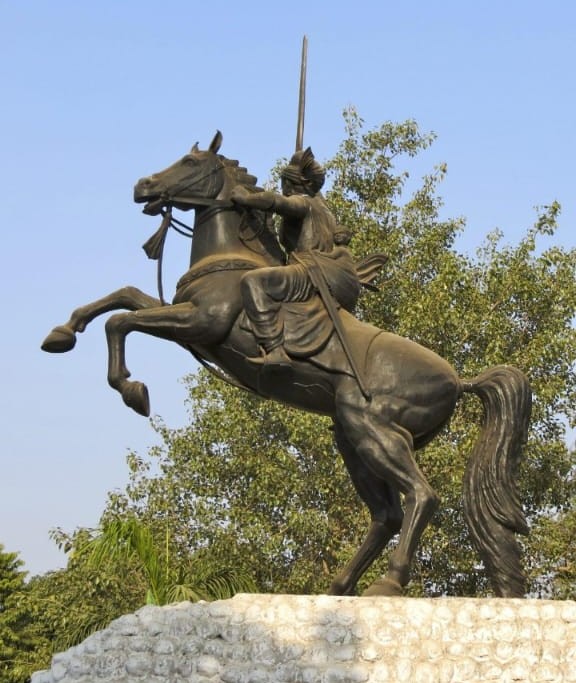
Few figures from nineteenth-century India remain as widely remembered as Rani Lakshmibai of Jhansi. Over time, her name has come to represent not only the resistance of Jhansi during the Revolt of 1857, but also a broader moment in Indian history when questions of sovereignty, colonial authority, and local rule collided with lasting consequences. More than a century after her death, she continues to be studied as one of the central figures of that uprising.
Before she became the ruler of Jhansi, she was a young girl named Manikarnika, known within her family as Manu. She was born around 1828 in Varanasi, a city long regarded as a centre of learning and religion. Her upbringing is often described as different from that of many girls of her time. Alongside domestic education, she was trained in physical disciplines such as horse riding and swordsmanship. These skills, though unusual for girls in her era, were part of the environment in which she grew up and later became central to how her life was remembered.
As she matured, Manikarnika married Gangadhar Rao, the ruler of Jhansi. With this marriage, she became Rani Lakshmibai and assumed the responsibilities associated with the royal household.
Historical accounts describe her as attentive to governance and engaged in administrative matters within the kingdom. Jhansi at the time was one of several princely states navigating its position under the increasing influence of the British East India Company, which was steadily expanding its control across India.
Her early married life was marked by both stability and tragedy. The couple lost their infant son, an event that deeply affected them. In an effort to secure succession and the continuity of the royal line, they adopted a young boy as their heir. Not long afterward, Gangadhar Rao passed away, leaving Lakshmibai as a young widow and the guardian of Jhansi’s future.
It was during this period that Jhansi’s political position became increasingly uncertain. British policy under the Doctrine of Lapse allowed the annexation of princely states whose rulers died without a biological male heir. Despite the adoption of a successor, British officials refused to recognize the child’s claim to the throne. Jhansi was informed that it would be placed under British administration.
Lakshmibai resisted this decision. She maintained that Jhansi had a legitimate heir and that the kingdom should remain under its traditional line of succession. Her refusal to accept annexation placed her in direct opposition to British authorities at a time when colonial expansion was intensifying across the subcontinent.
She took over the administration of Jhansi and focused on strengthening its internal structure. The fort was reinforced, and efforts were made to prepare for the possibility of conflict. While tensions were rising, broader unrest was also building across India, fueled by political grievances, military dissatisfaction, and widespread opposition to British policies. In 1857, this unrest erupted into what is now commonly referred to as the Revolt of 1857.
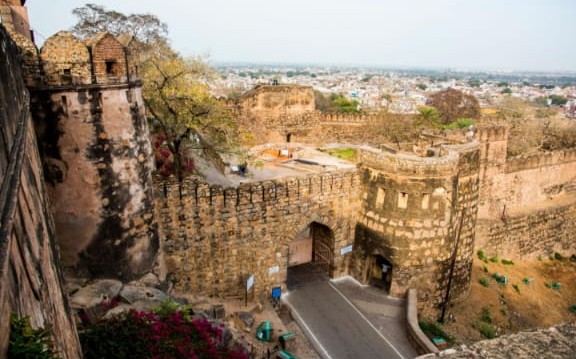
Jhansi soon became one of the significant centres of resistance. The British forces eventually moved to capture the city and laid siege to its fort. The fighting that followed was prolonged and intense. Contemporary accounts suggest that Lakshmibai was actively involved in the defence, not only as a symbolic leader but also in coordinating military efforts within the fort.
As the siege continued, conditions within Jhansi deteriorated. The strength of the British forces made long-term defence increasingly difficult.
In this context, Lakshmibai left the fort with her adopted son. Her escape, often described in historical narratives, marked a turning point in the resistance effort. From Jhansi, she moved toward other regions where opposition to British rule was still active.
In the aftermath of Jhansi’s fall, she joined forces with other leaders involved in the uprising. Among them were figures such as Tatya Tope, who continued to resist British authority in different parts of central India. Lakshmibai remained engaged in these efforts, moving from one theatre of conflict to another during a period of widespread but fragmented resistance.
By 1858, British forces were reasserting control over much of the territory that had briefly fallen under rebel influence. Lakshmibai’s final military engagement took place near Gwalior, a strategically important region at the time.
In the battle that followed, she sustained fatal injuries and died at approximately twenty-nine years of age. Her death marked the end of one of the most recognisable individual stories of the uprising.
In the years after the revolt was suppressed, British authority was consolidated more firmly under the Crown, ending the rule of the East India Company. Within India, however, the memory of the uprising persisted in different forms, including oral traditions, literary accounts, and later nationalist histories. Within these narratives, Rani Lakshmibai gradually emerged as one of its most prominent figures.
Her legacy developed over time through a combination of historical record and cultural memory. She was remembered not only for her role in defending Jhansi, but also for her position as a female ruler who assumed military and political responsibility during a period of crisis. In many accounts, she became associated with the broader idea of resistance against colonial rule.
Today, Rani Lakshmibai of Jhansi is studied as part of both Indian history and the wider history of anti-colonial movements.
Her life reflects the complexities of a period marked by political transition, contested authority, and armed conflict. While interpretations of her actions vary across sources, her presence in historical memory remains firmly established.
More than a century and a half later, her story continues to be revisited in scholarship, literature, and public discourse. It remains tied not only to the events of 1857, but also to ongoing discussions about leadership, sovereignty, and the role of women in moments of historical change.
By Rukayya Muhammad Adam