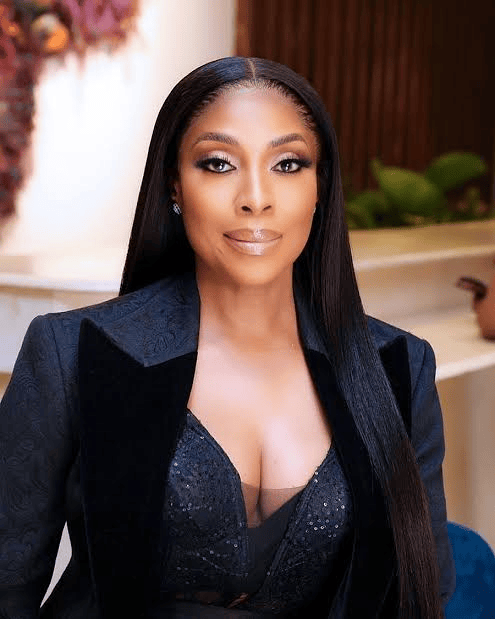
There is a woman in Lagos whose face has been stolen and manipulated by artificial intelligence, whose voice has been cloned to deceive unsuspecting victims, and whose reputation has been tested in public. Yet through it all, she has continued to build, create, and inspire. Her name is Mo Abudu, and her story is one of resilience, vision, and unwavering determination.
Born Mosunmola Abudu on September 11, 1964, in Hammersmith, London, to Nigerian parents from Ondo Town, her journey has always bridged two worlds. At the age of seven, she was sent to live with her grandmother in Nigeria, an experience that deepened her connection to her heritage. Four years later, tragedy struck when her father, an engineer, passed away. She returned to England carrying a loss that would shape her resilience from an early age.
She completed her education in the United Kingdom, attending Ridgeway School before studying at MidKent College and West Kent College. At just 19, she was selected as AVON Cosmetics’ brand ambassador for the African market, an early indication of the confidence and charisma that would later define her career.
Mo Abudu went on to earn a Master’s degree in Human Resource Management from the University of Westminster, laying the foundation for a successful corporate career. Decades later, in recognition of her extraordinary contributions to broadcasting and media, the same institution awarded her an honorary Doctor of Arts degree.
Her professional journey began in 1987 as a recruitment consultant in the United Kingdom. She later joined the Starform Group before returning to Nigeria in 1993 to lead Human Resources and Training for ExxonMobil through Arthur Andersen. In 2000, she established her own consultancy, Vic Lawrence & Associates, while also contributing to the development of the Protea Hotel in Oakwood Park. By every conventional measure, she had already achieved remarkable success.
Yet success was not enough.
In 2004, at the age of 40, she made the bold decision to leave the security of corporate life. There was no crisis, no obvious reason to walk away, only a conviction that she was meant for something greater.
That conviction led her into media.
In 2006, she launched Moments with Mo, Africa’s first pan African syndicated talk show under Inspire Africa. The programme became a groundbreaking platform for meaningful conversations and marked the beginning of a remarkable transformation.
The defining moment came on July 1, 2013, with the launch of EbonyLife TV, Africa’s first global Black entertainment network. The road was filled with skepticism, financial hurdles, and technical challenges. Many questioned whether African stories could resonate with a global audience. Mo Abudu refused to accept those limits.
Her faith in African storytelling soon proved justified.
In 2014, she founded EbonyLife Films, which went on to produce acclaimed films including Fifty (2015), The Wedding Party, one of Nigeria’s highest grossing films, The Royal Hibiscus Hotel, Chief Daddy (2018), and Your Excellency (2019).
Her influence soon extended far beyond Nigeria. Sony Pictures Television entered a partnership with EbonyLife in 2018, followed by AMC Networks in 2019. That same year, Netflix signed a landmark multi title agreement with EbonyLife, making it the first African production company to secure such a deal. In October 2020, Òlòtūré premiered on Netflix, boldly confronting the realities of human trafficking through an authentically African perspective.
The milestones continued. Blood Sisters became Netflix’s first Nigerian original series, reaching the platform’s Global Top 10 with more than 11 million viewing hours. BBC Studios also partnered with EbonyLife, further strengthening its international reach.
Beyond filmmaking, Mo Abudu remained committed to developing the next generation of storytellers. She established the EbonyLife Creative Academy, providing free professional training for aspiring filmmakers, and created EbonyLife Place, a luxury entertainment and hospitality destination in Lagos.
Her achievements earned widespread recognition. She appeared on Forbes’ list of the World’s 100 Most Powerful Women for three consecutive years, was named among the TIME100 Most Influential People, became a Harvard Executive Fellow, and in 2024 was appointed a Creatives Champion for the UK Africa Investment Summit.
Even after decades of success, she continued expanding her vision. In November 2025, she launched EbonyLife ON Plus, her own streaming platform, while also announcing a 50 million dollar Afro Film Fund to support African filmmakers. She acquired property in central London for EbonyLife Place London, produced Baby Farm for Netflix, and collaborated with Idris Elba on Dust to Dreams.
Challenges, however, never disappeared.
In March 2026, following Showmax’s announcement that it would exit Africa, Mo Abudu urged African creatives to stop waiting for international companies to define the industry’s future and instead build sustainable platforms of their own.
Then came a deeply personal attack.
In May 2026, fraudsters circulated an AI generated video using her likeness and cloned voice to falsely promise Nigerians ₦700,000 per day. She responded immediately, explaining that the clip had been manipulated from a 2023 interview and warning the public that she had never solicited money from anyone.
Only weeks later, in July 2026, another disappointment followed when a Nigerian court dismissed her appeal in a defamation case she had pursued for 17 years concerning a 2009 publication she believed had damaged her reputation.
Many people would have retreated.
Mo Abudu kept building.
Her story is not simply about television, filmmaking, or business. It is about refusing to allow criticism, setbacks, technological abuse, or legal disappointments to define her future. She transformed African storytelling into a global enterprise, created opportunities for countless creatives, and proved that the world is ready for African stories when they are told with excellence and conviction.
Mo Abudu’s greatest achievement may not be the awards she has won or the companies she has built. It is the example she continues to set. Resilience, vision, and courage can outlast every obstacle. She refused to be silenced, and in doing so, she changed the story of African cinema forever.
By Umm e Habiba, Pakistan.