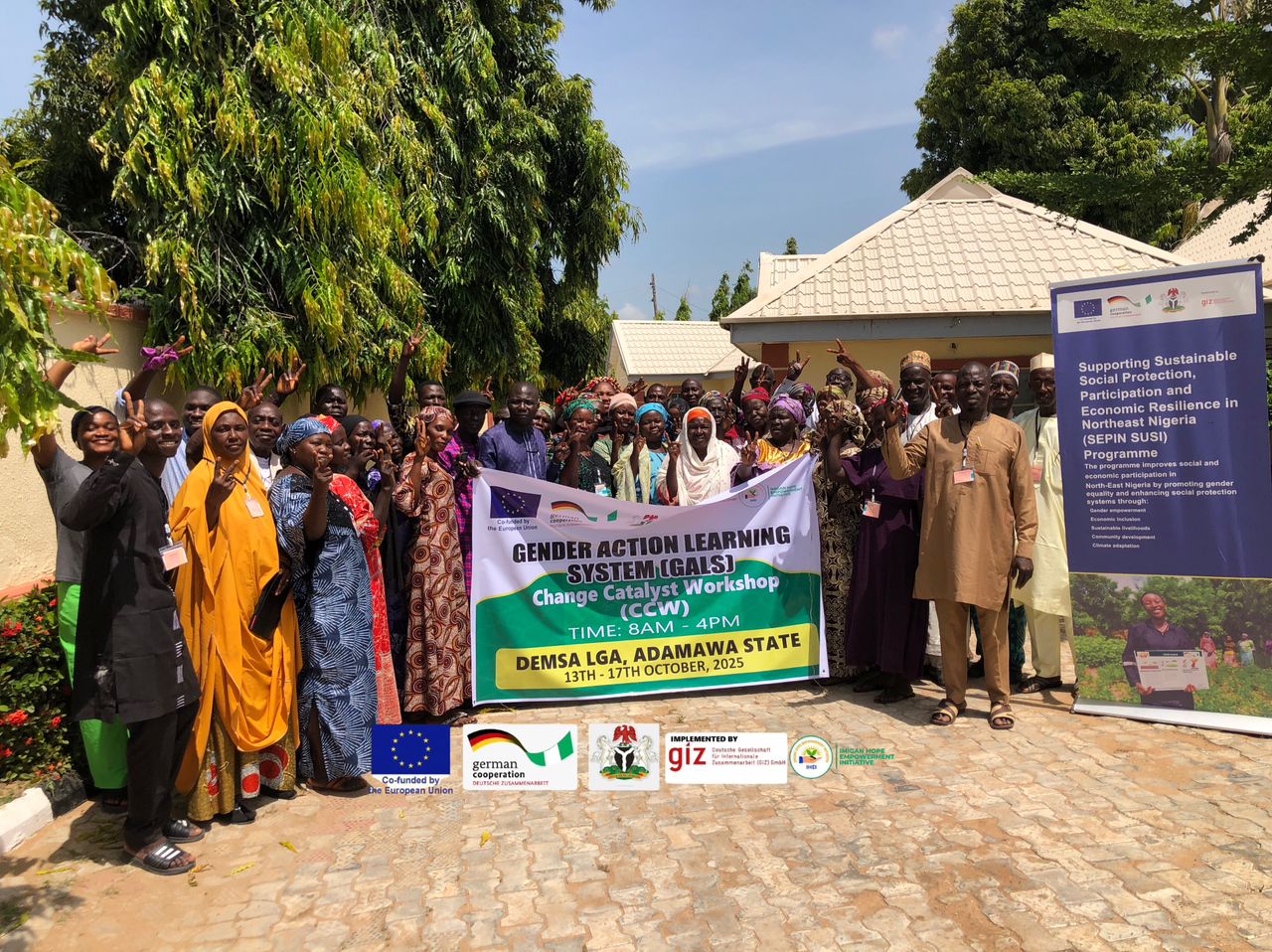
A five-day Gender Action Learning System (GALS) Change Catalyst Workshop was successfully held in Demsa bringing together community members and leaders from four areas: Farai, Old Demsa, Dwam, and Nassarawo.
The core objective was to introduce and train participants in GALS tools to enable them to facilitate positive changes, address household challenges, and amplify women’s voices in leadership and decision-making within their households and communities.
Key Activities and Achievements
The training focused on practical application and collective problem-solving, with participants actively engaging with several GALS tools:
- Visioning and Vision Road Journey: Participants, including married couples, utilized these tools to collectively envision a more equitable future for their families and communities. The Vision Road Journey helped them map out the steps and timelines required to achieve this shared vision, fostering mutual accountability.
- Happy Family Tree: This tool was particularly effective in allowing participants to analyze the current state of their households and identify areas of imbalance. Crucially, the participation of some husbands alongside their wives led to concrete commitments to amplify women’s voices in leadership and decision-making within the home and the wider community, setting a foundation for more equitable household governance.
- Challenge Action Tree: Community members and leaders collaboratively used the Challenge Action Tree to diagnose the root causes of socio-economic and gender-based challenges. They then developed practical, locally led action plans to address these issues at the household and community levels. The training was facilitated by a consultancy firm- IMIGAN foundation, GIZ, ROHI and JRS with 50 participants, 34 women and 16 men.
- Gender tracking Tools: This allows users to identify specific gender gaps (e.g., in pay, political representation, or. Essentially, a gender tracking tool helps an organization establish a baseline of inequality, monitor whether their actions are closing the gap over time, and hold themselves accountable for access to resources) and to understand the different needs of men and women. These tools also incorporate checklists and frameworks for Gender Analysis, which ensures new policies or projects do not unintentionally harm women or widen existing inequalities, a process known as gender mainstreaming achieving tangible results, moving the effort from mere intention to measurable impact.
- Community Engagement and Success Sharing: A major highlight was the field visit to a Community action Group (CAG) in Mugareng. ROHI, GIZ, and JRS staff supervised the meeting, where the CAG members shared their success stories, demonstrating the tangible impact of the GALS methodology. The group also presented their acquired knowledge, showcasing a deep understanding of the principles learned during the sessions.
Success Story From 2024 GALS Training
Mama Caroline shared a powerful success story about the impact of the GALS training on her household. Before ROHI came into the community, her husband was a traditional man who believed women should handle all the house chores and responsibilities. However, by December, following the GALS training in Demsa, he completely changed. He started actively helping her with the house chores, a shift that initially drew mocking names from some community men.
Despite the peer pressure, her husband remained resolute, having understood, and embraced the need to support her at home. Mama Caroline happily reported that they are now a much happier family, having done their Family Visioning together, and are actively working towards achieving their shared dreams. She further noted, “My husband has changed since after the training; he helps at home. He takes the Change Agent Group (CAG) sessions seriously, and serves as the gender equality champion within the community, creating awareness and sensitizing others.
Gender Action Learning Systems (GALS) is an approach that empowers communities, particularly women and girls, to identify and address gender inequalities in their daily lives.
GALS aims to create lasting change by equipping communities with the tools and confidence to drive their own development and promote gender equality.
Ajijir Martin
Adamawa, Nigeria