Title: Overlapping Disparities: How Women’s Exclusion Deepens Social and Global Climate Crises.
SYNOPSIS OF THE WEBINAR
Just like every other sector, women are excluded from climate change conversations.
But the climate crisis is not gender-neutral; the inclusion of women in climate action is therefore necessary because it intersects deeply with existing inequalities.
Empowering women strengthens climate action; ignoring these gender dynamics makes climate efforts less effective, less just, and ultimately less successful.
Women are the first victims of climate change; fully including them in decision-making, policy design, implementation, and leadership is essential and non-negotiable in solving the climate crisis and combating climate change.
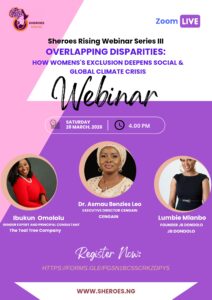
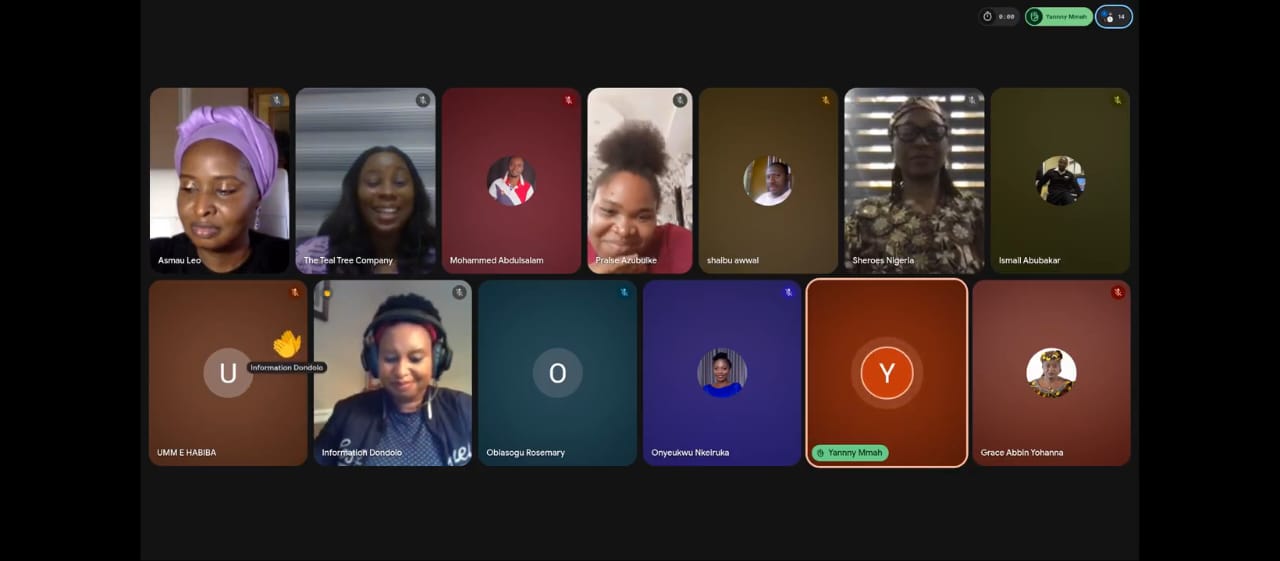
In commemoration of IWD 2026, Sheroes Rising for Development Initiative brought 3 gender and climate change experts together on 28th March 2026 to analyze and articulate the importance of women in climate action.
Sheroes Rising for Development Initiative Webinar Series III, titled “Overlapping Disparities: How Women’s Exclusion Deepens Social and Global Climate Crises,” brought together leading women’s voices from across Africa to explore the intersections of gender inequality and climate action.
Featuring Ambassador. Dr. Asmau Benzis Leo, Mrs. Ibukun Omololu of The Teal Tree Company, and Mrs. Lumbie Mlambo of JB Dondolo Foundation, Zimbabwe, the Sheroes Rising Webinar Series III.
At the heart of the issues of climate change is this key concept of intersectionality,
WEBINAR CONVERSATIONS
Climate change acts as a “threat multiplier” for women affected by poverty, restrictive norms, limited education, and geographic constraints. These inequalities do not just operate in isolation, but interact with each other to produce compounded disadvantages.
Dr. Leo identified structural, institutional, and sociocultural challenges, urging women to “begin to think about climate-friendly approaches and climate adaptation, because in the next few years, the future of the world is unpredictable.
A gender and peacebuilding specialist with extensive years of experience in governance, humanitarian work, and development. Dr Leo is the Executive Director of CENGAIN. She leads initiatives on gender-based violence and inclusion, represents Nigeria globally, and advances Women, Peace, and Security and sector reform efforts.
Economic inequality makes women have less access to capital and financial services. Women also suffer from time poverty and educational gaps, which have created a lot of underrepresentation in leadership, especially where policymakers and decision makers discuss climate change.
As sociocultural norms often limit women’s voices and mobility, solutions require multi-level coordination, including “integrating gender-responsive budgeting into climate policy and climate governance structures” and promoting shared household responsibilities and engagement of men and boys as allies.
Women are often the “first victims” of climate change. They are overrepresented in terms of responsibility because they are the ones doing all the unpaid care work. Women’s unique contributions include ”context-specific ecological knowledge,” “livelihoods-linked approaches,” “collective and communal leadership,” and “long-term thinking rooted in care.”
Mrs. Ibukum Omololu’s recommendation for policymakers and funders was to “institutionalize gender accountability within climate finance and governance frameworks,” ensuring that no climate project is funded without “clear gender participation metrics” and supporting women-led grassroots solutions.
Ibukun is a gender expert and consultant with broad experience in advancing women’s empowerment and financial inclusion. She leads impactful global initiatives, supports development programs, and promotes inclusive growth. A speaker and author, she champions gender equality, leadership, and socio-economic development across Africa and beyond.
From Zimbabwe, Lumbi Mlambo illustrates how climate shocks exacerbate gender inequalities.
“In many rural communities in Zimbabwe, when drought intensifies, or water resources dry up, it is women and girls who must walk longer distances, up to 15 to 18 miles a day, to fetch water.”
Excluding women from decision-making leads to failed solutions; therefore, when women are excluded, climate solutions fail. Putting women into decision-making roles, not just advisory roles, funding women-led solutions directly, not through a proxy. design with women, not for women, remove structural barriers, and measure influence, is key to women’s participation and impact in climate change solutions.
Lumbie Mlambo is a Zimbabwean impact Entrepreneur dedicated to improving clean water access and empowering underserved women and girls. Through her organization, she leverages innovation and advocacy to drive global change, promote inclusion, and advance sustainable development, serving as a leader, speaker, and role model for transformative social impact.
CONCLUSIONS
The importance of grassroots data collection and deliberate selection of participants to reflect lived realities was highlighted. Mrs. Mlambo noted that if women are the ones in the front lines getting things done, actually the ones directing what should be done, we can move forward faster and better.
Never underestimate the power of numbers. You can leverage, you can negotiate, you can do anything with the power of numbers.
-Ibukun OMololu
Mrs Omolu’s summation emphasised that women’s exclusion from decision-making, access to resources, and opportunities does not occur in isolation. It overlaps with broader systemic issues such as poverty, limited education, and unequal rights.
In the context of the global climate crisis, these layered inequalities make women more vulnerable to environmental shocks while also limiting their ability to contribute to solutions.
When women are left out of climate action and policy spaces, societies miss out on critical knowledge and inclusive strategies that could strengthen resilience. As a result, women’s exclusion not only deepens existing social disparities but also accelerates the impacts of climate change, creating a cycle that reinforces both inequality and environmental instability.
The Sheroes Rising Webinar Series III concluded with the affirmation that:
Women are a part of the solution, not the problem. The problem is exclusion.
There is therefore an urgent and critical need for inclusive, gender-responsive climate action, and committed to continuing these conversations through future webinars and programs because women’s inclusion isn’t optional or “extra”; it’s a practical necessity for faster, fairer, and more effective climate progress.
Sheroes Editorial