

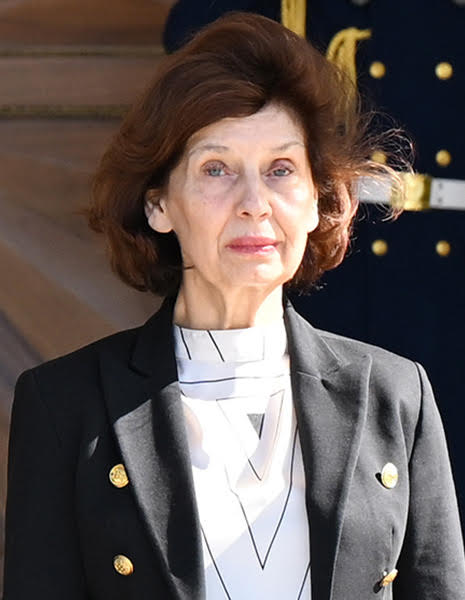
On 11 May 1953, Gordana Siljanovska-Davkova was born in Ohrid, a historic city in what was then the Socialist Republic of Macedonia, part of Yugoslavia.
Decades later, she would become the first woman elected president of North Macedonia, following a career that took her from the lecture halls of the country’s oldest university to its parliament and, eventually, its highest elected office.
Siljanovska-Davkova spent much of her childhood in Skopje after her family moved to the capital. She completed her primary and secondary education there before enrolling at the Faculty of Law at Ss. Cyril and Methodius University in Skopje.
She graduated in 1978 and continued at the same university for her master’s degree. Her academic ambitions later took her to Ljubljana, then part of socialist Yugoslavia, where she pursued doctoral studies.
In 1994, she defended her doctoral dissertation, Local Self-Government, Between Norms and Reality, at the University of Ljubljana, graduating cum laude.
The subject would become particularly relevant to her later career. Her academic work focused extensively on constitutional law, political systems, local self-government and the relationship between institutions and citizens.
The same year she obtained her doctorate, Siljanovska-Davkova returned to Ss. Cyril and Methodius University as an assistant professor.
She became an associate professor in 1999 and a full professor of constitutional law and political systems in 2004.
Over the course of her academic career, she authored or co-authored more than 200 scholarly works and became closely associated with the development of clinical legal education in Macedonia, promoting practical legal training alongside traditional classroom teaching.
In 2016, she was recognized by students at the Faculty of Law as its most inspiring professor, an honour that became one of the notable recognitions of her academic career.
Her transition into electoral politics came later.
In 2019, Siljanovska-Davkova ran for president for the first time as the candidate of the opposition VMRO-DPMNE party. She finished first in the first round but lost the runoff to incumbent Stevo Pendarovski by roughly eight percentage points.
The defeat did not end her political career.
In 2020, she entered parliament and became chair of its Commission for Equality of Women and Men, giving her another platform from which to engage with issues of constitutional governance and gender equality.
Five years after her first presidential bid, she returned to the race.
The 2024 presidential election produced a decisive victory. Siljanovska-Davkova won the first round and went on to secure about 69 per cent of the vote in the runoff, defeating Pendarovski and becoming the first woman elected president of North Macedonia.
Her victory marked a historic moment in a country where the presidency had previously been held exclusively by men.
Addressing supporters after the election, she highlighted the significance of electing a woman to the country’s highest office.
“Is there a bigger change than electing a woman as president? I will stand with women in taking this great step forward, a step towards reform,” she said.
She also presented herself as a president for the entire country, regardless of political affiliation or ethnic identity.
“I will be president of all citizens, to all ethnic groups, to party members and to those who belong to no party at all,” she said.
Her presidency began with a diplomatic controversy.
During her inauguration, Siljanovska-Davkova referred to her country simply as “Macedonia” rather than using its official constitutional name, “Republic of North Macedonia”, during the presidential oath. The Greek ambassador left the ceremony, while Greece criticised the omission as inconsistent with the Prespa Agreement, the 2018 accord that settled the long-running dispute over the country’s name.
Siljanovska-Davkova maintained that she would respect the country’s international obligations while continuing to express her personal position on the name issue.
In her inaugural address, she also linked political reform with the role of women in public life.
“With the help of us women, you male politicians will also change and Macedonia will become a decent place to live,” she said.
Her concerns about the country’s democratic institutions had appeared long before she reached the presidency.
During her 2019 presidential campaign, she argued that democracy in the country remained incomplete and stressed the importance of the separation and balance of political power.
Her career has also included significant engagement with European constitutional institutions.
From 2008 to 2016, she served as a representative of her country on the Venice Commission, the Council of Europe’s advisory body on constitutional matters and the rule of law.
She has also received recognition for her contributions to constitutional law and gender equality, including an honour from the OSCE Mission and a medal from the Women’s Union of Macedonia.
Siljanovska-Davkova’s journey from academia to the presidency was not built around a single political breakthrough.
It was shaped over decades through legal scholarship, teaching, constitutional advocacy, parliamentary work and two presidential campaigns.
The woman who once studied the relationship between legal norms and political reality eventually entered the political system she had spent much of her career examining.
From the university lecture hall to the presidential office in Skopje, Gordana Siljanovska-Davkova’s career has traced an unusual path through academia, constitutional law and electoral politics, culminating in a historic achievement as North Macedonia’s first woman president.
By Umm e Habiba, Pakistan