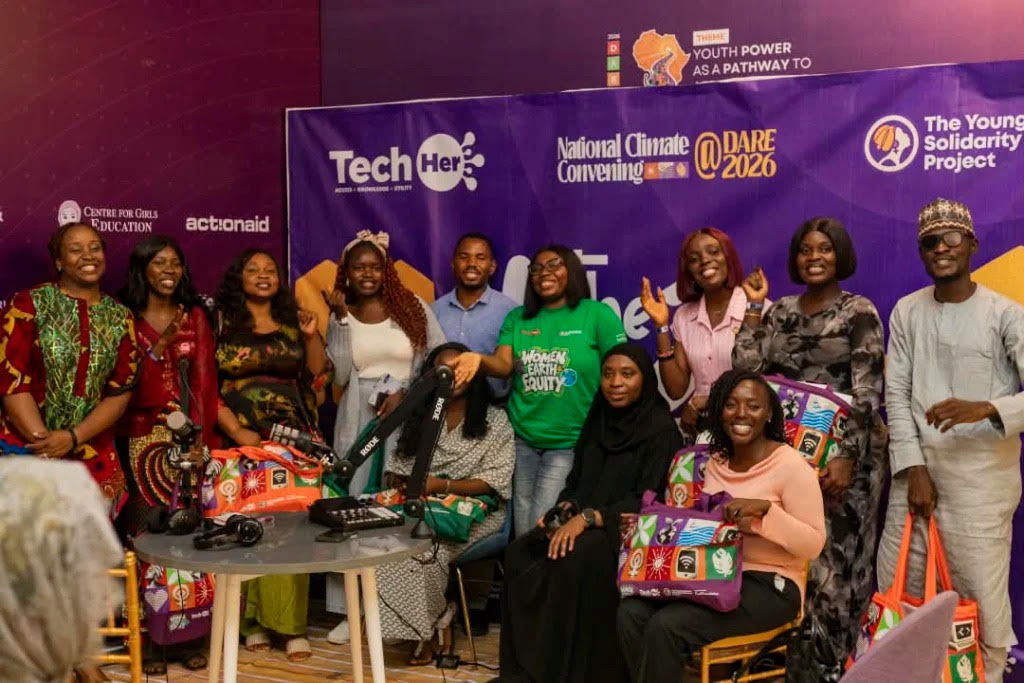
Women must take a more active role in shaping community governance, controlling data and using technology to address inequalities, climate challenges and gender-based violence, experts have said at the Dare 2026 conference in Abuja.
Speaking at the conference, Ken Henshaw, Executive Director of We the People, urged women to stop waiting for inclusion in male-dominated community institutions and instead establish alternative structures through which they could exercise collective power.
“Power is never given; it is taken. So women need to create a dual power structure. There is a need to be something different—a dual power structure,” he said.
Henshaw encouraged women to use technology to develop independent systems of community governance, arguing that alternative platforms could strengthen their bargaining power and challenge existing leadership structures.
“I would propose that using the tools of technology, women should pull out of all male-dominated institutions of community governance, pull out of it completely, and create their own,” he said.
He further explained that technology and data are not neutral, as the collection, control and application of information determine whose experiences are recognised and whose needs receive attention.
According to him, technology can help address inequalities arising from climate change and ecological crises, particularly those affecting women and persons with disabilities.
He highlighted how environmental disasters often destroy farmland and fishing grounds on which many women depend for their livelihoods, while men may have greater opportunities to seek alternative sources of income.
To address this imbalance, Henshaw called on relevant authorities to collect and analyse climate-related data based on gender, documenting the number of women and men affected and the financial losses they experience.
He said such information would help ensure that compensation, environmental restoration and disaster response programmes are fair and responsive to the different experiences of affected communities.
Community Data Can Strengthen Climate Action
Ibiso Ikiroma-Owiye of the Grassroots to Global Sustainable Development Network also emphasised the importance of data in making technology effective.
She explained that technological systems depend on the quality of information used to develop and operate them.
“Whatever you see technology do, it’s the data and the information that has been fed to that technology. That’s what the technology is acting on,” she said.
Ikiroma-Owiye noted that community-generated data could improve the accuracy of tools such as remote sensing and Geographic Information Systems (GIS).
She explained that information provided by residents about their surroundings could help these technologies predict floods early enough for households and farmers to protect their homes, farmland and livelihoods.
According to her, rural women and other community members possess valuable knowledge of local environmental and weather patterns, which can strengthen early warning systems and reduce disaster-related losses.
She also highlighted the potential of technology to help communities monitor the activities of oil companies, document environmental degradation and report violations to relevant authorities.
“Technology is essential for climate action, particularly when combined with experiences from vulnerable communities,” she said.
Experts Call for Equal Justice Against Technology-Facilitated Abuse
The conference also addressed technology-facilitated gender-based violence, with Chioma Agwuegbo, Executive Director of TechHer, calling for stronger legal protections and equal access to justice for women and girls.
She warned that online abuse often has serious offline consequences for survivors, affecting their safety, dignity and wellbeing.
Agwuegbo also raised concerns about the role of artificial intelligence in making digital abuse easier to carry out anonymously and rapidly.
She urged social media platforms to develop content moderation systems that take Nigerian languages and cultural realities into account, noting that approaches designed without local context may fail to protect affected communities effectively.
She highlighted TechHer’s Kuram platform, which receives reports from survivors and works to connect them with pathways to justice.
The platform engages with digital platforms, the police and the Nigeria Security and Civil Defence Corps to pursue reported cases and promote accountability.
Agwuegbo stressed that access to justice should not depend on an individual’s financial position, educational background or political connections.
“Nigeria has laws, whether we like it or not. Nigeria has laws that appropriately used, can help survivors achieve justice,” she said.
She further emphasised that accountability must apply equally to everyone, regardless of social or political status.
“The message that we are preaching is that justice should be linear, applied to the rich and the poor, the educated, the uneducated, the politically connected, the non-politically connected,” she added.
She called on the government to strengthen public safety through effective legislation and enforcement measures capable of deterring offenders.
Beyond addressing online abuse, Agwuegbo encouraged young people to use digital platforms productively to earn income, establish professional connections, obtain certifications and access educational opportunities.
Amplifying Young Women’s Voices in Climate Action
Agwuegbo also discussed TechHer’s Young Feminist Solidarity Climate Project, funded by the Ford Foundation, which seeks to amplify the voices of feminist climate activists in Nigeria, Ghana and Senegal.
The initiative focuses on women and girls who experience disproportionate effects of climate change and supports efforts to promote community-driven responses to environmental challenges.
She explained that the project had brought together activists from northern and southern Nigeria to exchange experiences and share practical solutions to issues including desertification, erosion, oil spills, violence and food insecurity.
The discussions highlighted the importance of recognising women as contributors to climate solutions rather than treating them only as victims of environmental challenges.
Organised by TechHer in partnership with Youth Hub Africa, the Dare 2026 conference was held on Saturday and featured the experiences, initiatives and solutions of young ecofeminists from across Nigeria.
According to the News Agency of Nigeria (NAN), the gathering connected grassroots climate action with broader discussions on youth development, governance, technology and social change.
The conference underscored the importance of placing data, technology and community knowledge in the hands of those most affected by inequality and environmental challenges, while strengthening women’s participation in decisions that shape their lives and communities.
By Umm e Habiba, Pakistan