Across the world, communities are confronting the growing impacts of climate change, such as stronger storms, prolonged droughts, rising temperatures, and shrinking natural resources. These challenges threaten livelihoods, food systems, and economic stability.
Yet within this global crisis lies another urgent reality: gender inequality continues to shape who suffers most and who has the power to influence solutions.
Women often stand at the intersection of environmental vulnerability and social exclusion. In many communities, they are responsible for securing water, cultivating crops, and managing household resources. These roles place them in close connection with nature and environmental systems.
When droughts dry up water sources or unpredictable rainfall damages crops, women must find ways to adapt to protect their families and communities.
However, despite their central role in sustaining households and local economies, women frequently remain excluded from the decisions that shape climate responses. Policies designed to address environmental challenges are often developed without including the voices of those most directly affected.
But when women are absent from leadership and decision-making spaces, the strategies created may fail to reflect the realities experienced at the community level.
This exclusion creates overlapping disparities that deepen both social and environmental crises. In many parts of the world, women face limited access to land ownership, financial services, education, and climate-resilient technologies.
But without these resources, their ability to adapt to changing environmental conditions becomes restricted. And as climate pressures increase, these inequalities become even more pronounced, reinforcing cycles of poverty and vulnerability.
The consequences extend far beyond individuals and families as communities lose valuable knowledge and innovative ideas that could strengthen climate resilience.
Women possess a deep understanding of local ecosystems, sustainable farming practices, and community needs. In many rural areas, they are the primary caretakers of natural resources and biodiversity. When these perspectives are ignored, climate strategies miss opportunities for more effective, inclusive, and sustainable solutions.
Empowering women is therefore not simply a matter of fairness; it is a strategic necessity for addressing the climate crisis.
Research and experience consistently show that when women participate in leadership and environmental governance, communities develop stronger and more adaptive responses to climate challenges. Women leaders often prioritize long-term sustainability, community welfare, and resource protection, all of which are essential for building climate-resilient societies.
Programs that promote mentorship and leadership development play a crucial role in advancing this transformation.
Addressing climate change requires more than technological innovation or environmental policies. It demands inclusive leadership that recognizes the knowledge, resilience, and potential of women as equal stakeholders in the climate crisis.
Governments, institutions, and communities must work together to remove barriers that limit women’s participation in spaces of decision-making, including climate action.
When women are empowered, not only do entire communities benefit. Opportunities expand, resilience grows, and solutions become more inclusive and effective.
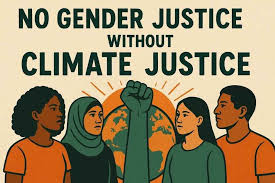
The message is clear: climate justice cannot be achieved without gender equality.
Umm E Habiba
Punjab, Pakistan