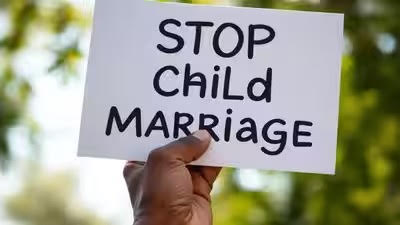
Every three seconds, somewhere in the world, a girl is married before she reaches adulthood.
More than 12 million girls are married each year before the age of 18. Behind that statistic are children whose education, health, safety and choices can be profoundly affected by a decision they did not make.
One of them is Zemzem.
The girl who was taken
Zemzem was 13 when she was abducted while walking to a shop in Derrera, in Ethiopia’s Sidama region.
Three men took her to an unfamiliar house with the intention of forcing her into an early marriage, a practice that continues to threaten girls in some rural communities.
Her rescue came a day later.
Members of a UNICEF-supported youth group learned about the abduction and joined Zemzem’s father, Jemal Kedir, in searching for her. They located the men and handed them over to the authorities.
For Kedir, the ordeal was terrifying. But he remained hopeful that his daughter would return home.
Her mother, Hajitu Mohammed, wanted something simple for her daughter: the opportunity to remain in school before considering marriage.
Zemzem knew exactly what she wanted.
“I want to learn, study and make my dad proud,” she said.
She dreams of becoming a teacher. Mathematics is one of her favourite subjects, and she hopes to teach children not only mathematics but also about child marriage, drawing on her own experience to show other girls that they have choices.
A community begins to change
Zemzem’s rescue was not simply an isolated intervention. It reflected changes taking place within her community.
According to a local social worker identified by UNICEF as Abraham, Derrera had previously recorded between 15 and 20 child marriage cases within a seven-month period. The number has since fallen significantly.
Community attitudes have also begun to shift.
Previously, girls’ marriages could be settled through discussions between families. Abduction, however, was increasingly being recognised as a serious violation rather than an offence that could be resolved through an apology.
Zemzem’s story was published by UNICEF in March 2024. Her experience illustrates both the danger girls face and the difference that community awareness, youth engagement and timely intervention can make.
But for millions of other girls, help does not arrive in time.
A global crisis
At a United Nations side event on justice for girls in March 2026, UNICEF Executive Director Catherine Russell highlighted the violence and discrimination experienced by girls around the world.
She noted that girls continue to experience violence that often goes unreported. They are, she said, “forced into marriages, and they are denied education.”
The consequences extend beyond the wedding itself.
Child marriage can interrupt education, increase exposure to violence, limit economic opportunities and expose girls to early pregnancy and its associated health risks.
Russell pointed to efforts in countries including Ghana and India. In Ghana, UNICEF has supported child-friendly courts, while in India, a 2024 Supreme Court judgment called for comprehensive measures to eliminate child marriage.
By June 2026, UNICEF reported that its programmes had helped protect nearly 10.4 million adolescent girls at risk of child marriage.
The progress matters. But the scale of the problem remains enormous.
Why 11 October matters
The International Day of the Girl Child was established to put girls’ rights on the global agenda.
Its roots can be traced to the 1995 Beijing Declaration and Platform for Action, which identified girls’ rights as a specific area requiring international attention. Plan International’s Because I Am a Girl campaign subsequently helped build momentum around the issue, while Canada led the initiative that eventually reached the United Nations General Assembly.
On 19 December 2011, the General Assembly adopted Resolution 66/170, designating 11 October as the International Day of the Girl Child. The first observance took place in 2012.
This year’s theme is “End child marriage and invest in girls’ rights.”
The theme returns to one of the central challenges that shaped the day from its beginning.
Fourteen years after the first observance, child marriage remains widespread.
The numbers behind the struggle
UNICEF estimates that around one in five girls worldwide is married before the age of 18. Approximately 650 million women and girls alive today were married as children.
Sub-Saharan Africa has the highest prevalence, with about 31 per cent of girls married before adulthood.
But the figures also contain evidence of progress.
An estimated 68 million child marriages have been averted over the past 25 years, driven by factors including girls’ education, legal reform and social protection.
UNFPA Executive Director Diene Keita told the agency’s Executive Board in February 2026 that child marriage and female genital mutilation were declining, while stressing that progress remained too slow.
By June, UNFPA reported that more than 28 million girls had received life-skills training and comprehensive sexuality education through a joint programme with UNICEF aimed at ending child marriage.
Education is part of the solution
Child marriage is closely connected to whether a girl can remain in school.
According to United Nations figures, about 133 million girls are currently out of school, while almost four in 10 adolescent girls and young women do not complete upper secondary education.
Girls aged 15 to 19 are twice as likely as boys to be outside education, employment or training.
In fragile and conflict-affected settings, the gap becomes even more severe. Girls are significantly more likely to be excluded from secondary education, increasing their vulnerability to early marriage and other forms of exploitation.
The relationship works both ways: keeping girls in school can reduce their risk of child marriage, while marriage itself can make returning to education much more difficult.
The United Nations identifies several measures that can help: keeping girls in school, expanding health and protection services, working with communities to challenge harmful social norms, and investing in girls’ rights and leadership.
Pakistan’s legal battle
In Pakistan, the fight has increasingly moved into the courtroom and parliament.
Girls Not Brides estimates that 29 per cent of girls in Pakistan marry before the age of 18, while 4 per cent marry before turning 15.
In May 2025, President Asif Ali Zardari signed legislation establishing 18 as the minimum marriage age in Islamabad for both girls and boys. Previously, the legal minimum was 16 for girls and 18 for boys.
The legislation was passed unanimously by the National Assembly and introduced penalties, including imprisonment for people who facilitate or coerce child marriages.
The Council of Islamic Ideology opposed the legislation, declaring it un-Islamic. The law nevertheless came into force.
Senator Sherry Rehman, who was involved in the legislative effort, described its passage as “a long and difficult struggle.”
The legal debate continued at provincial level.
On 11 May 2026, the Punjab Child Marriage Restraint Act 2026 came into force, replacing a 97-year-old law that had provided a lower minimum age for girls.
Under the new legislation, child marriage is a cognizable and non-bailable offence. An adult who marries a girl under 18 can face imprisonment and a fine.
The law also places the best interests of the child at the centre of proceedings and makes clear that a minor’s consent does not override concerns involving coercion, abduction or exploitation.
But legislation alone cannot end child marriage.
The real test is whether girls and families know their rights, whether authorities enforce the law and whether a girl in a rural community can access protection before a marriage takes place.
When the school door closes
The connection between education and child marriage is also visible in countries where girls are systematically excluded from school.
At the Education World Forum in 2026, Nobel Peace Prize laureate Malala Yousafzai spoke about conversations she had with young women in Nigeria, where girls told her they needed to fight early marriage and wanted policies that would allow married and pregnant girls to return to school without stigma.
Her own experience shaped that message.
Malala has spoken frequently about her mother growing up in a village without a secondary school for girls. When Malala later sought to build a school, she recalled being told that it could not be done.
Afghanistan presents a starkly different picture.
In August 2026, UNESCO reported that approximately 2.4 million girls were being denied access to secondary education in the country, an increase of about 200,000 from the previous year.
UNESCO warned that the number could approach four million by 2030 if the restrictions continue.
The consequences are educational, economic and social. UNESCO estimates that the restrictions could cost Afghanistan billions of dollars in lost income over the coming decades, while also increasing the risk of early and forced marriage.
When girls lose access to education, the choices available to them become narrower.
A story beyond survival
Zemzem is not the only girl whose story illustrates both the harm caused by child marriage and the possibility of recovery.
The United Nations has also highlighted the story of Salma, who was forced into marriage at 15.
“I was just a child and suddenly got married,” she said.
She became pregnant soon afterwards and experienced gender-based violence.
But her story did not end there.
Salma eventually returned to school and continued pursuing her ambition of becoming a doctor.
Her journey points to an important part of the fight against child marriage: prevention matters, but so does giving survivors a pathway back to education, safety and opportunity.
What 11 October asks of us
Ending child marriage requires more than declaring a day of international observance.
It requires laws that protect girls and are actually enforced. It requires schools that remain open to them. It requires health and protection services that girls can reach. It requires communities willing to question practices that place children at risk.
And it requires girls themselves to have a voice in decisions affecting their lives.
Zemzem was fortunate because people noticed what had happened and acted quickly.
Her story is a reminder of what becomes possible when a community refuses to look away.
On 11 October, the International Day of the Girl Child asks the world to do more than count the girls who are being denied their childhood.
It asks governments, communities and individuals to protect their rights, expand their choices and invest in the futures they are entitled to build.
Because behind every statistic is a girl with a name, an education she deserves, a future she has the right to choose—and, like Zemzem, a dream of her own.
By Umm e Habiba, Pakistan.