
The Girl Who Refused to Disappear: The Sarah Qureshi Story
Imagine sitting in a classroom full of men who are silently betting on how long you will last. No other girl beside you. No expectation that you will make it past the first semester. Now imagine not only surviving that room, but walking out years later having invented something that could change the way every airplane on Earth affects the sky.
That is not fiction. That is the story of Sarah Qureshi.
Born in Islamabad, Sarah grew up in a home where science was not just a subject, but part of everyday life. Her father, Masood Latif Qureshi, a physicist and inventor with a deep connection to aviation, often allowed her to sit beside him while he worked on engines.
While other children played outside, she learned how machines behaved, how systems responded, and how ideas became engineering. That early exposure shaped a curiosity that never left her.
Even before completing her degree, she was already working. Between 1997 and 2000, while still a student, she interned in engineering roles, gaining hands-on experience long before most of her peers had entered a workshop.
Then came engineering school.
When Sarah enrolled at the National University of Sciences and Technology (NUST) to study mechanical engineering, she quickly realized she was the only woman in her class. Not one of a few. The only one. Every classmate, every lab partner, and every expectation in the room reflected a world that had not been designed for her presence.
She has described the experience as difficult but formative. She had to work harder, prove herself repeatedly, and endure silence where others might have found support. What sustained her was her family and a small circle of mentors who refused to let her quit. In 2001, she graduated with a bachelor’s degree in mechanical engineering, having outlasted every doubt placed in her path.
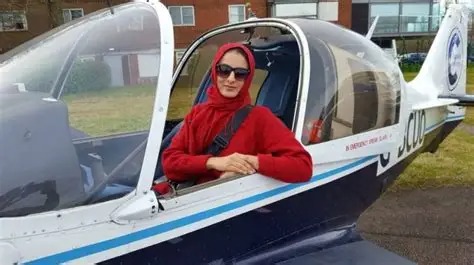
After graduation, she entered Pakistan’s automotive industry, gaining practical engineering experience. Along the way, she also earned her private pilot’s license—an early signal of the direction her ambitions were beginning to take.
She later moved to the United Kingdom to pursue advanced studies at Cranfield University, one of the world’s leading aerospace research institutions. There, she completed a master’s degree in aerospace dynamics and continued her training in aviation. She went on to pursue a PhD in aerospace propulsion.
Between 2015 and 2017, during her doctoral research, she also supervised master’s students working on jet engine technologies. The same student who once sat alone in a classroom was now guiding others in the field.
Around this time, everything began to converge.
In 2017, she and her father co-founded Aero Engine Craft, an aerospace innovation company focused on environmentally responsible aviation. She served as CEO, leading both research and development efforts.
By 2018, while working on her PhD research, she identified a critical gap in aviation science that had long been overlooked: contrails—those white streaks left by aircraft that contribute significantly to global warming. Rather than attempting to avoid them, she and her father pursued a more ambitious idea: eliminating them at the source.
Their solution involved integrating a condensation system into a jet engine design to prevent contrail formation during flight. The concept evolved into a working prototype designed for real-world testing.
The invention secured two international patents. While full commercial deployment would still require years of development, the innovation marked a major step forward in climate-conscious aviation technology and placed Pakistan’s private sector on the global map for environmental engineering.
Recognition followed.
In 2023, she received the Study UK Alumni Award in Pakistan for Science and Sustainability. In 2024, she was awarded the Tamgha-i-Imtiaz, one of Pakistan’s highest civilian honours, for her contributions to science and engineering. By 2025, she was named among the Asian Scientist 100, highlighting her influence in advancing scientific innovation in the region.
The girl who once sat alone in a classroom filled with doubt is now part of a global conversation on climate and aviation. She did not simply survive being underestimated.
She transformed it into fuel for invention.
And in doing so, she turned isolation into impact, and persistence into progress.
Umm E Habiba,
Punjab, Pakistan.