

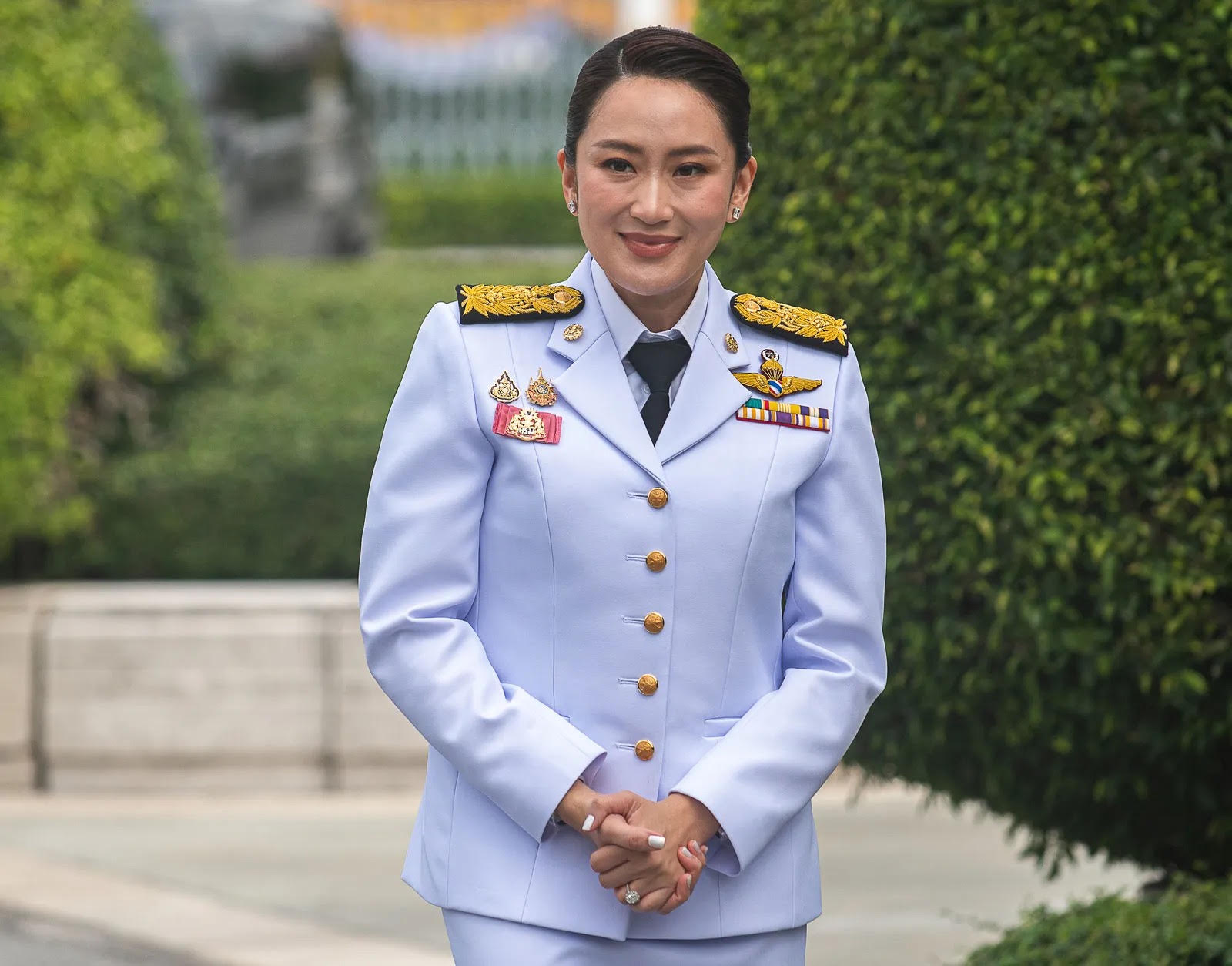
From McDonald’s Counter to Thailand’s Top Job: The Rise and Fall of Paetongtarn Shinawatra
In March 2004, an 18-year-old Paetongtarn Shinawatra put on a red-and-yellow uniform and stood behind a McDonald’s counter in a Bangkok shopping mall.
Her father was Thailand’s prime minister.
Thaksin Shinawatra, a self-made telecommunications billionaire who had built his fortune before entering politics, believed his daughter should still experience the discipline of ordinary work. So Paetongtarn clocked in like any other teenager. On her first shift, her father reportedly walked into the restaurant and bought a takeaway meal from his daughter.
The image—a prime minister buying a burger from his teenage daughter—became a memorable piece of Thai political folklore. Beneath the novelty was a lesson about privilege: wealth and political power, her father believed, should not exempt his children from learning what work feels like.
Two decades later, Paetongtarn would occupy the highest political office in the country herself.
But her journey from a teenager behind a fast-food counter to Thailand’s youngest prime minister was anything but straightforward.
Born on August 21, 1986, in Bangkok, Paetongtarn grew up in one of Thailand’s most politically powerful families. Her father’s name was already becoming synonymous with wealth, politics and controversy.
At eight, she accompanied him when he took his first government position as foreign minister. She attended Saint Joseph Convent School and Mater Dei School before studying political science, sociology and anthropology at Chulalongkorn University, graduating in 2008. She later earned a master’s degree in international hotel management from the University of Surrey in England in 2009.
Her family’s prominence was recognized early. In 2005, she received the Order of the Direkgunabhorn, Gold Medal, Sixth Class, a Thai royal honour.
Her early professional life, however, was rooted in business rather than politics.
Paetongtarn became the largest shareholder of SC Asset Corporation, holding a 28.5 percent stake that was once valued at nearly five billion baht. She also served as chief executive of Rende Development, her family’s hotel business, before her sister assumed the role.
By 2022, she controlled interests in 21 companies with an estimated combined value of around 68 billion baht.
But growing up a Shinawatra meant that politics was never far away.
In 2006, when Paetongtarn was 20, Thailand’s military overthrew her father’s government in a coup while he was abroad. She took refuge in a safe house as soldiers moved through Bangkok.
Two years later, she watched her father leave the country, beginning what would become 15 years of self-imposed exile.
For years, Paetongtarn remained largely outside frontline politics. Then, almost suddenly, she stepped into the centre of it.
Her political rise accelerated in 2023, when she became one of the Pheu Thai Party’s candidates for prime minister. She was campaigning while heavily pregnant with her second child.
Her son was born on May 1, 2023. Her daughter, born in January 2021, was still a toddler.
The campaign did not stop.
In August 2024, Thailand’s parliament elected Paetongtarn prime minister following the removal of her predecessor. At 37, she became Thailand’s youngest prime minister and the second woman to hold the office.
She was also the first child of a former Thai prime minister to become prime minister herself.
Yet Paetongtarn was determined to present herself as more than an extension of her father.
“I am my dad’s daughter, always and forever, but I have my own decisions,” she said during the campaign.
In government, she pursued an economic agenda that included the 10,000-baht digital wallet programme, plans for a trillion-baht land bridge linking Thailand’s eastern and western coasts, and an aggressive push to expand tourism.
Her government also moved against scam networks operating along the Myanmar border, including measures to cut electricity and internet connections to suspected scam centres. The action drew international attention and praise, including from Chinese President Xi Jinping.
She survived a no-confidence vote in March 2025 with 319 votes in her favour.
But political survival would prove more difficult than parliamentary survival.
Earlier that year, Paetongtarn herself became the target of an attempted scam involving an AI-cloned voice purportedly belonging to a foreign leader asking for donations. The incident offered a strange glimpse into the increasingly sophisticated threats confronting modern political leaders.
Then came the border crisis.
In May 2025, a Cambodian soldier was killed in a clash near the Thai-Cambodian border. With tensions rising and fears of a wider conflict growing, Paetongtarn sought to use a personal relationship to defuse the crisis.
She called Hun Sen, Cambodia’s former prime minister and a longtime acquaintance of the Shinawatra family.
Her intention, she later said, was to prevent escalation.
Before the call, she had publicly insisted that Thailand would not surrender its territory.
“We will not give away even one square inch of land,” she said, while arguing that war should never result from a misunderstanding.
But the private conversation became politically explosive.
During the call, Paetongtarn told Hun Sen that if he wanted anything, “he can just tell me, and I will take care of it.” She also referred to a senior Thai military figure as being among “our opponents.”
Hun Sen subsequently leaked the recording.
The political fallout was immediate.
A coalition partner withdrew from her government. Public pressure mounted. Thailand’s Constitutional Court suspended her from office and later removed her in a six-to-three ruling.
The woman who had risen to the premiership at 37 was suddenly fighting for her political survival.
After her removal, Paetongtarn defended the intention behind the call.
“My intention was to save lives, that’s what I intended to communicate,” she said.
She later stepped down as leader of the Pheu Thai Party, saying she wanted the party to rebuild without her name becoming a burden. She nevertheless remained associated with what she described as the Pheu Thai family.
Her story now carries two very different images.
There is the teenager in a McDonald’s uniform, serving a meal to a customer who happened to be her father, the prime minister.
There is the daughter of a billionaire politician who inherited one of Thailand’s most powerful political names.
There is the businesswoman with enormous family wealth, the pregnant candidate who continued campaigning, and the 37-year-old who became Thailand’s youngest prime minister.
And there is the politician whose attempt to prevent a border conflict ultimately contributed to her own political downfall.
Questions about her wealth, family business interests, university admission and other aspects of her background have followed her throughout her public life. So too has the larger question that has shadowed the Shinawatra family for decades: where does personal ambition end and political inheritance begin?
Paetongtarn never denied being her father’s daughter. Instead, she insisted that she could carry his name without surrendering her own judgment.
History may ultimately remember both parts of that claim.
She was born into power, learned to live with its privileges and burdens, and eventually reached the highest office in Thailand.
But in politics, inheritance can open the door.
It cannot guarantee what happens after you walk through it.
Umm E Habiba, Punjab, Pakistan.