

For decades, the conversation around domestic violence has largely centered on women; however, another reality has remained largely hidden from public discourse. Millions of men also experience abuse in their intimate relationships. Their stories are rarely told, their experiences are often dismissed, and many continue to suffer in silence.
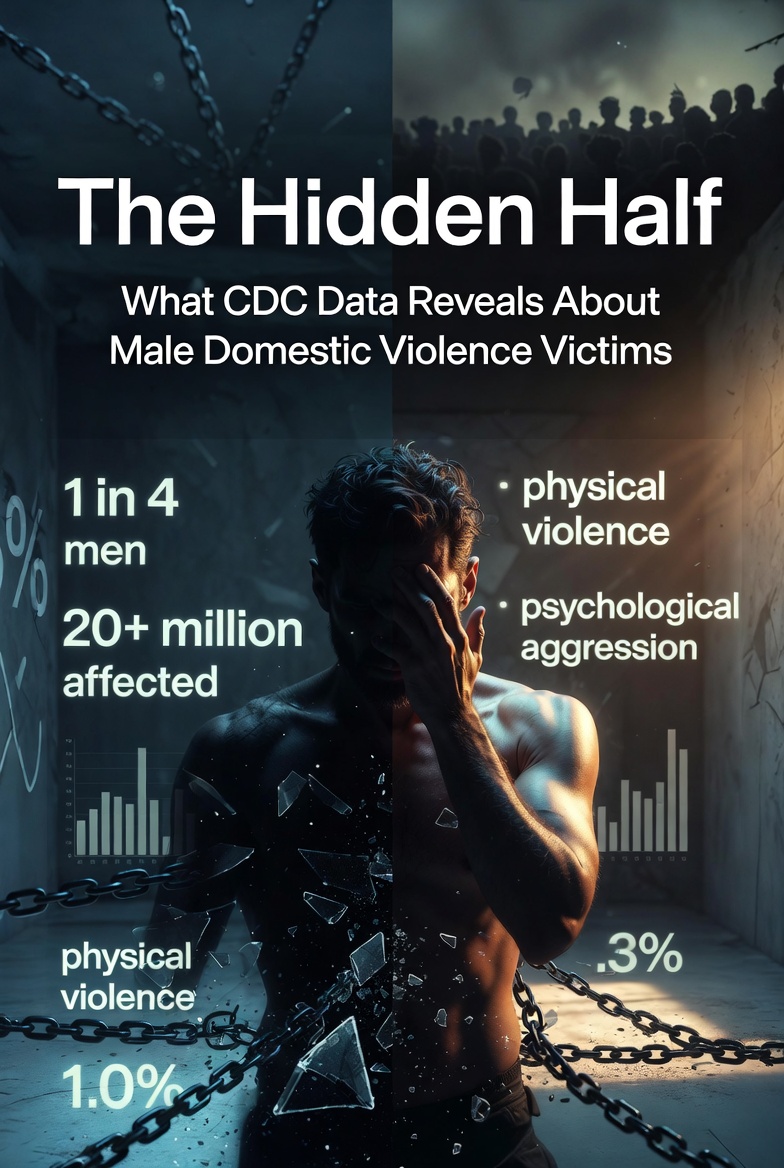
The latest findings from the U.S. Centers for Disease Control and Prevention (CDC) provide compelling evidence that male victimization is far more common than many people realize. According to the CDC’s National Intimate Partner and Sexual Violence Survey (NISVS), approximately one in four men, about 26%, have experienced contact sexual violence, physical violence, or stalking by an intimate partner during their lifetime and suffered related impacts. This translates to more than 20 million men whose lives have been profoundly affected by intimate partner violence.
The CDC’s data reveal an even broader picture of abuse. Nearly 14% of men have experienced physical violence by an intimate partner during their lifetime, while more than 53 million men have experienced psychological aggression. In a single year alone, nearly one million men reported experiencing physical violence from an intimate partner. These are not just statistics. They represent fathers, sons, husbands, brothers, colleagues, neighbors, and friends whose pain often goes unseen because it does not fit society’s expectations of who a victim should be.
The evidence does not stop with the CDC. It is reinforced by decades of peer-reviewed research from leading scholars in the field. Among them is Denise A. Hines, a psychologist and the Elisabeth Shirley Enochs Endowed Professor of Social Work at George Mason University’s College of Public Health. Professor Hines has spent years researching domestic violence and sexual abuse, with a particular focus on prevention, intervention, public policy, and the experiences of underrecognized victims of intimate partner violence. Her research has been supported by the National Institute of Mental Health and the National Institute of Child Health and Human Development, among other federal agencies. This is not advocacy-driven commentary. It is federally funded, peer-reviewed research that arrives at the same conclusion as the CDC’s own findings.
Male victimization is real, measurable, and remains structurally under-addressed.
Looking more closely at the CDC’s data reveals another reality that is often overlooked. According to the NISVS, women were the primary perpetrators of intimate partner violence reported by male victims. In cases of stalking against men, perpetrators included both women and men. Even in several categories of sexual violence experienced by men, the offender was frequently a woman. These findings challenge the long-held assumption that domestic violence always involves a male perpetrator and a female victim. Rather than supporting a single universal pattern, the evidence demonstrates that intimate partner violence occurs in multiple forms and affects people across genders.
Domestic violence against men is frequently misunderstood because many people equate abuse solely with physical assault. In reality, abuse takes many forms. Psychological manipulation, coercive control, intimidation, threats, financial abuse, isolation from loved ones, false accusations, and emotional degradation can be just as damaging as physical violence. For many male victims, these invisible forms of abuse leave lasting emotional scars that affect their mental health, confidence, relationships, careers, and overall quality of life.
One of the greatest barriers facing male victims is silence. Many men never disclose their experiences because they fear they will not be believed or taken seriously. Some worry they will be ridiculed for not being “strong enough” to defend themselves. Others fear losing custody of their children, damaging their reputations, or being wrongly identified as the perpetrator instead of the victim.
These fears often discourage men from seeking help, leaving them trapped in abusive relationships without the support they desperately need.
The consequences of overlooking male victims are measurable. Men who experience intimate partner violence report fear, ongoing concern for their safety, symptoms of post-traumatic stress disorder, anxiety, and depression. These are the same types of trauma responses that policymakers and healthcare professionals rightly recognize as serious when experienced by female victims.
Trauma does not become less real because the person experiencing it is male. Yet the systems designed to respond to domestic violence, including shelters, hotlines, legal advocacy services, and many funding mechanisms, have historically been developed with female victims as their primary focus.
As a result, many men seeking help encounter confusion, disbelief, or a lack of appropriate services.
Recognizing male victims should never be viewed as diminishing the experiences of women. Women continue to experience disproportionately higher rates of severe and fatal intimate partner violence and remain in urgent need of protection and support. Acknowledging male victims is not about creating competition between survivors or shifting attention away from women. Rather, it is about ensuring that every person experiencing abuse is seen, heard, and able to access appropriate care. Domestic violence is fundamentally about power, control, and harm, not about gender alone.
The CDC’s findings challenge policymakers, healthcare professionals, law enforcement agencies, researchers, and community organizations to adopt a more inclusive response to domestic violence. Public awareness campaigns should reflect the reality that men can also be victims. Healthcare providers and frontline professionals should receive training to recognize signs of abuse in men without allowing stereotypes to cloud their judgment. Support services, including counselling, legal assistance, emergency accommodation, and crisis intervention, should be available to every survivor, regardless of gender.
Perhaps most importantly, society must begin replacing stigma with compassion. Every survivor deserves to be believed. Every survivor deserves dignity. Every survivor deserves access to safety, justice, and healing.
The CDC’s data do not ask us to replace one narrative with another. Instead, they invite us to broaden our understanding of domestic violence and to acknowledge the hidden half of this global crisis.
When we recognize the experiences of male victims alongside those of women, we strengthen our collective response to abuse. A truly effective movement against domestic violence leaves no survivor invisible.
As we continue to advocate for safer homes and healthier relationships, let us commit ourselves to building systems that respond to evidence rather than assumptions, compassion rather than stereotypes, and justice rather than silence.
Because no victim, regardless of gender, should ever have to suffer alone.
Halima Layeni
Founder of the Life After Abuse Foundation & Author of ‘Dear MEN’